Table of Contents
Richland County Courts, IL *

Richland County is a rural county in southeastern Illinois. The county was established in 1841 and has an approximate population of 15,813. The county seat for Richland County is Olney. Richland County is home to the largest population of albino squirrels in the United States, who even have the right of way on local streets.
The Richland County Court system is responsible for handling legal matters for the people of Richland County and its surrounding areas. As part of Illinois's unified justice system, the court system handles major and minor criminal and civil cases, including family law matters and cases involving the affairs of the deceased, in Richland County daily. Attorneys and locals also depend on this court system to file cases, access court records, and protect their constitutional rights. For this reason, they should understand how the Richland County Court system functions to navigate the system seamlessly.
Overview of the Richland County Court System
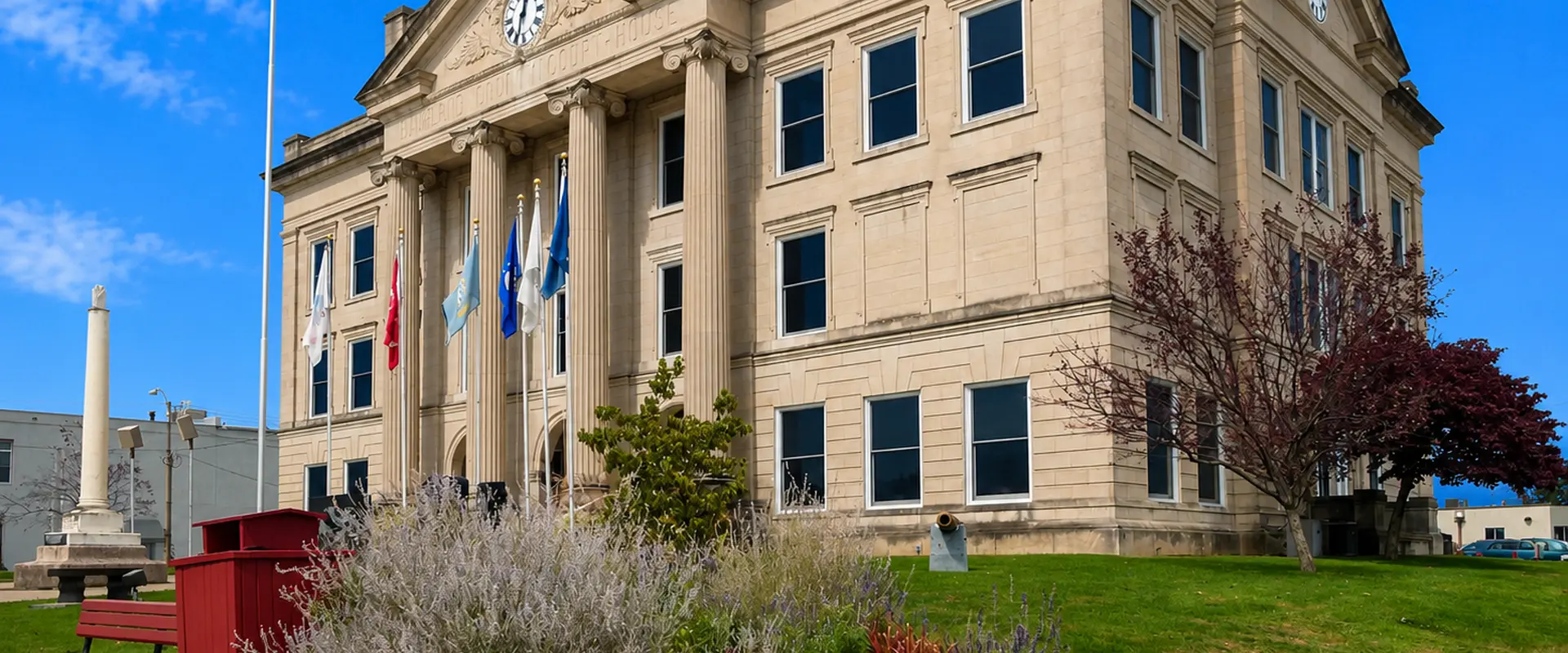
The Richland County Courthouse is located in Olney. The Richland County Circuit Court operates as part of the Illinois Second Judicial Circuit Courts and the Fifth District Appellate Courts. The Circuit Court is responsible for all legal matters, minor or major, including those from criminal, civil, family law, and probate matters. Individuals who believe the rulings in their cases were unjust can appeal to the Fifth Appellate District of Illinois. There are no local or municipal courts within this court system.
The Richland County Circuit Court cases are presided over by an elected Circuit Court Judge and an Associate Judge. Other court staff includes the trial court administrator and the Richland County Circuit Clerk, who is the custodian of court records and administrative head responsible for assisting individuals with e-Filing and collecting fees and fines.
Types of Courts in Richland County, Illinois

The Richland County court system is part of the overall unified court system of the Second Judicial Circuit Courts of Illinois. This means there is a single trial court handling all legal matters in Richland County. There are no county courts, town courts, or local municipal courts.
 Circuit Court
The Richland County Circuit Court is the only trial court in Richland County. And because the county is pretty small, the court system is not divided into subdivisions like other Illinois counties, with various divisions responsible for specific legal matters. The Richland County Circuit Court has jurisdiction over major and minor legal matters of the county, including:
- Civil (lawsuits, small claims, and evictions)
- Criminal (Felonies, misdemeanors, and traffic violations)
- Family and Juvenile matters (divorces, child support, orders of protection, and juvenile matters)
- Probate (wills, estates, and legal guardianships)
Primary location: Richland County Courthouse
How to Access Richland County Court Records

The Richland County Circuit Clerk is responsible for collecting, digitizing, and archiving Richland County court records. Court records are public information, except for family law matters involving minors, adoption proceedings, sealed or expunged criminal records, and records containing sensitive information, such as Social Security numbers. Members of the public can view, inspect, copy, and use for personal research. Individuals can access Richland County court records in person at the Richland County Courthouse, online via the Richland County Circuit Clerk portal, or on commercial platforms.
 Online Access
Richland County court records are available online through multiple platforms. The first place to access official court records online is the Richland County Circuit Clerk website. This is perfect for individuals searching for historical records, as the website lists all relevant links to access court records. Additionally, one can access court records through official Illinois state platforms, such as re:SearchIL. This website allows residents to search court cases throughout Illinois, not just Richland County. People who don't have access to a computer terminal can view court documents online via the kiosks at the county courthouse.
 Alternative Online Options
In addition to official state platforms, one can also access Richland County court records through CourtCaseFinder. CourtCaseFinder is perfect for individuals who want to avoid the hassle of searching for court records on government portals, where records are fragmented or incomplete because clerks take time to upload new ones. The platform is great for performing personal research and conducting due diligence. CourtCaseFinder aggregates court records from multiple jurisdictions, making them available through a single dashboard. It's efficient, streamlined, and optimized for mobile for the best experience.
 In-Person Requests
Apart from online access, Richland County court records are also available through in-person request at the Richland County Circuit Clerk's Office. In-person requests are recommended for individuals who require clerk-stamped or certified records usable in court. Certified court records are legally binding. Additionally, if an individual cannot find specific records online, they can use the public terminal computers available at the clerk's office to conduct an extensive search. Once one finds the records, they can request standard copies or certified copies from the clerk's office. The clerk's office charges a small fee for court records.
 Archived Records
When Richland County court records are no longer used actively within the courts, they are archived. The Circuit Clerk archives inactive court records to create space for newer records. These archived court records are sometimes moved to an off-site location. Archiving records is the responsibility of the circuit clerk. One of the primary repositories for storing Richland's archived records is the Illinois Regional Archives Depository (IRAD) located at Eastern Illinois University (EIU). Records available in this location include historic, civil, and criminal case files, chancery, divorce records, probate cases, and naturalization indexes. Digitized versions of these records are accessible through the Historical Records portal on the Richland County Circuit Clerk Portal.
For Attorneys and Legal Professionals
Attorneys, legal professionals, and visiting attorneys of the Richland County Court System must adhere to the Local Court Rules of the Illinois Second Judicial Circuit. For example, they must file a formal written appearance with the Clerk of the Circuit Court before they can appear in court. Visiting attorneys who are part of a local attorney team of record will not pay standard entry fees. Court hearings within the Richland County Court System can be held online via Zoom or in person at the court, as the court uses a hybrid system. Cases that can be heard via Zoom include specific status conferences, motions, or non-evidentiary hearings. Evidentiary hearings and criminal trials are done in person. Lastly, visiting attorneys can network with Richland County attorneys through the Illinois State Bar Association Lawyer Finder platform.
Attorneys and legal professionals should also adhere to the security procedures, such as screenings, and should not bring prohibited items to the court. While in court, they are expected to switch off their electronic devices except for those used during the court session. For administrative matters, they can channel any request through the Richland County Clerk's Office, including requests for court records, forms, or procedural guidance. Lastly, attorneys and legal professionals seeking to file a new case must use the eFileIL platform, as electronic filing is mandatory for civil cases in Richland County.
How to File a Case in Richland County

For successful filing, attorneys and self-representing litigants must follow the Illinois eFiling Procedures, including completing required forms, serving the defendant, and monitoring the case to ensure they don't miss any crucial updates.
Step 1: Choose the Correct Court
Individuals filing a case must file with the court that has jurisdiction over their case. In Richland County, identifying the court to file a case is pretty straightforward because there is only one court that is responsible for all legal matters. Therefore, whichever case an individual wants to file, they must file it with the Richland County Circuit Court, except for unresolved cases that fall under the jurisdiction of the Fifth District Appellate Court. Individuals filing new cases must file with the Richland County Circuit Court.
 Step 2: Complete Required Forms
The next step is to obtain appropriate court forms and complete them as required. Standardized and state-approved court forms are available on the Richland County Circuit Court Forms Page. After an individual obtains the forms, they must complete them appropriately. If they make any mistakes, the clerk will reject their case. Individuals with attorneys don't have to worry about this because their attorneys will handle the forms. Self-representing litigants, on the other hand, can get this right by using the Easy Forms platform to generate ready-to-upload forms. For civil cases, one must complete the summons and the complaint or petition forms.
 Step 3: File the Case
After completing the forms, one must download and save them as a PDF, as this is the standard file format accepted on the e-Filing platform. Each form should be on its own. Residents should not combine the forms into one PDF file. Now, the filer must upload these PDF files to the eFileIL portal. Individuals at the Richland County Courthouse can use the public terminal computers to file the case. There are exceptions to e-filing for specific individuals, but residents must submit an exemption request and have it granted to file in person.
 Step 4: Pay Filing Fees
Individuals filing must pay the statutory fees through the eFileIL platform for the case to be considered legally filed. The amount one will pay depends on the type of case and the monetary damage. Since minor civil cases have lower monetary damage, individuals filing such cases will pay a small fee. Individuals filing major civil cases of serious monetary damage will pay higher filing fees. One can confirm the respective filing fee through the Richland County Fee Schedule. If an individual cannot afford filing fees, they must apply for a fee waiver by completing the waiver form and uploading it to the e-Filing platform.
 Step 5: Serve the Other Party
The next step is for the plaintiff to serve the opposing party. This is referred to as the service of process. The plaintiff cannot perform this process themselves. They must use a third party, such as the Richland County Sheriff's Office, or hire a certified process server. The server must deliver the clerk-stamped copies in person and complete the Proof of Service, indicating that the defendant has been notified. The plaintiff must upload the Proof of Service on the e-Filing platform to notify the judge that service of process is complete.
 Step 6: Monitor the Case
After filing a case, the plaintiff must monitor it so they don't miss a mandatory court appearance, a deadline, or the judge's ruling, among other crucial updates. There are various ways one can monitor a case filed through the Richland County Court System. First is through the e-Filing platform dashboard. One can also track their case by searching the case number or party names through re:SearchIL. Lastly, one can also check the Richland County Court Calendar to see if any dates have been set. If the defendant doesn't file an answer after 30 days, the plaintiff can ask the judge for a default judgment.
Richland County Courthouse Directory
Richland County Courthouse
This courthouse is the center of operations for the Richland County Court System, especially the Circuit Court and the Clerk of the Circuit Court.
Olney
Address: 103 West Main Street, Olney, IL 62450
Phone: (618) 392 2151
Website: Richland County Circuit Court
Legal Help and Self-Help Resources
Self-representing litigants, the vulnerable, and low-income individuals in Richland County can find free legal assistance and local legal support through various self-help resources, non-profit organizations, and civil legal aid programs.
 Free Legal Assistance
Individuals visiting the Richland County Courthouse can use self-help resource centers available through the Olney Public Library. Within this library, individuals can use public terminals to search court records and file cases. Court staff is also available to help them find free legal information, step-by-step case filing guides, and statewide standardized forms. The same goes for the Richland County Courthouse Law Library. Other self-help resources are available through Illinois Court Help, Illinois Legal Aid Online (ILAO), and Illinois Free Legal Answers, where individuals can post civil case questions and get advice from volunteer attorneys virtually.
 Local Legal Support
Alternatively, low-income residents and senior citizens can find free civil legal services in Richland County through Land of Lincoln Legal Aid. This non-profit organization provides virtual and in-person help for full representation in court. Housing matters include eviction defense, landlord-tenant disputes, public housing issues, and foreclosure prevention. Family matters cases include domestic violence protection orders, divorce, child custody, guardianship, and elder law, defending the elderly from exploitation. This organization does not handle criminal cases or felonies. Individuals facing criminal matters in the Richland County Circuit Court who cannot afford to hire a private defense attorney must contact the Richland County Public Defender's Office for a court-appointed attorney.
FAQs
How do I search for a criminal case in Richland County?
One can search for criminal cases in Richland County using multiple channels, both online and in person. Criminal cases are available online through statewide court records providers in Richland County, such as re:SearchIL, to access case numbers, filed criminal charges, fine balances, upcoming schedules, and judges' case minutes. In addition to these online platforms, one can search criminal cases in Richland County in person at the Richland County Courthouse using the public terminals.
Are court records public in Richland County?
Yes. Richland County court records are public information. The Richland County Circuit Clerk is mandated to provide court records to the public through various online portals and public terminals. And to make them available to individuals who try to access them in person at the Clerk's Office. Members of the public can view, inspect, and copy court records through the Richland County Circuit Clerk Website or re:SearchIL.
Where can I find eviction records?
Eviction records in Richland County are categorized under the civil records. One can find eviction records through the Richland County Circuit Clerk Website and re:SearchIL. Eviction court records are also available in person at the Richland County Courthouse, and one can search through the state-provided public computer terminals. One can pay a small fee for standard copies or certified, legally binding copies.
Can I file a small claims case online?
Yes, one can file a small claims case online through the ODYSSEY eFileIL portal. Electronic filing is mandatory for small claims cases and all civil cases in Richland County, with a few exceptions. One can obtain and complete standardized small claims forms using Easy Form and upload them to the e-Filing platform. After that, they can pay the filing fees so that the small claims case can be legally filed.
When is it helpful to use a third-party records finder?
It is helpful to use a third-party records finder, such as CourtCaseFinder, when an individual wants to conduct multi-jurisdictional court record searches. CourtCaseFinder aggregates court records beyond Richland County, allowing searchers to access records from different courts, municipalities, counties, states, and the whole United States. Additionally, the platform is user-friendly and optimized for mobile devices, enabling users to search for court records effectively.
Other Counties in Illinois
- Adams
- Alexander
- Bond
- Boone
- Brown
- Bureau
- Calhoun
- Carroll
- Cass
- Champaign
- Christian
- Clark
- Clay
- Clinton
- Coles
- Cook
- Crawford
- Cumberland
- Dekalb
- Dewitt
- Douglas
- Dupage
- Edgar
- Edwards
- Effingham
- Fayette
- Ford
- Franklin
- Fulton
- Gallatin
- Greene
- Grundy
- Hamilton
- Hancock
- Hardin
- Henderson
- Henry
- Iroquois
- Jackson
- Jasper
- Jefferson
- Jersey
- Jo Daviess
- Johnson
- Kane
- Kankakee
- Kendall
- Knox
- La Salle
- Lake
- Lawrence
- Lee
- Livingston
- Logan
- Macon
- Macoupin
- Madison
- Marion
- Marshall
- Mason
- Massac
- Mcdonough
- Mchenry
- Mclean
- Menard
- Mercer
- Monroe
- Montgomery
- Morgan
- Moultrie
- Ogle
- Peoria
- Perry
- Piatt
- Pike
- Pope
- Pulaski
- Putnam
- Randolph
- Rock Island
- Saint Clair
- Saline
- Sangamon
- Schuyler
- Scott
- Shelby
- Stark
- Stephenson
- Tazewell
- Union
- Vermilion
- Wabash
- Warren
- Washington
- Wayne
- White
- Whiteside
- Will
- Williamson
- Winnebago
- Woodford
Table of Contents
