Table of Contents
Randolph County Courts, IL *

Randolph County is one of the oldest counties in the state, located in the southwestern part of Illinois. The county currently has approximately 30,000 residents and has its seat in Chester. The courts in Randolph County operate under a unified court system that handles all legal issues affecting the people. In most cases, people visit the courts to seek legal assistance with civil matters, family law issues, probate cases, juvenile issues, and minor traffic violations.
At the trial level, the court has only one Circuit Court that handles everything from minor civil small claims to serious felony-level issues. The structure is divided into divisions, with each one handling a specific case type. Knowing how the courts operate is a huge step towards ensuring one gets the justice that they deserve.
Overview of the Randolph County Court System
Randolph County is under the Illinois Unified Judicial System, which oversees all the processes and procedures at the courts. This means that all court processes within Randolph follow the same procedures defined by the system. Randolph County is served by the Twenty-Fourth Judicial Circuit of Illinois, which also takes care of three other counties: Monroe, Perry, and Washington. In the circuit, the Circuit Judges and Associate Judges work together to ensure that all legal matters are heard and that people receive the justice they deserve.
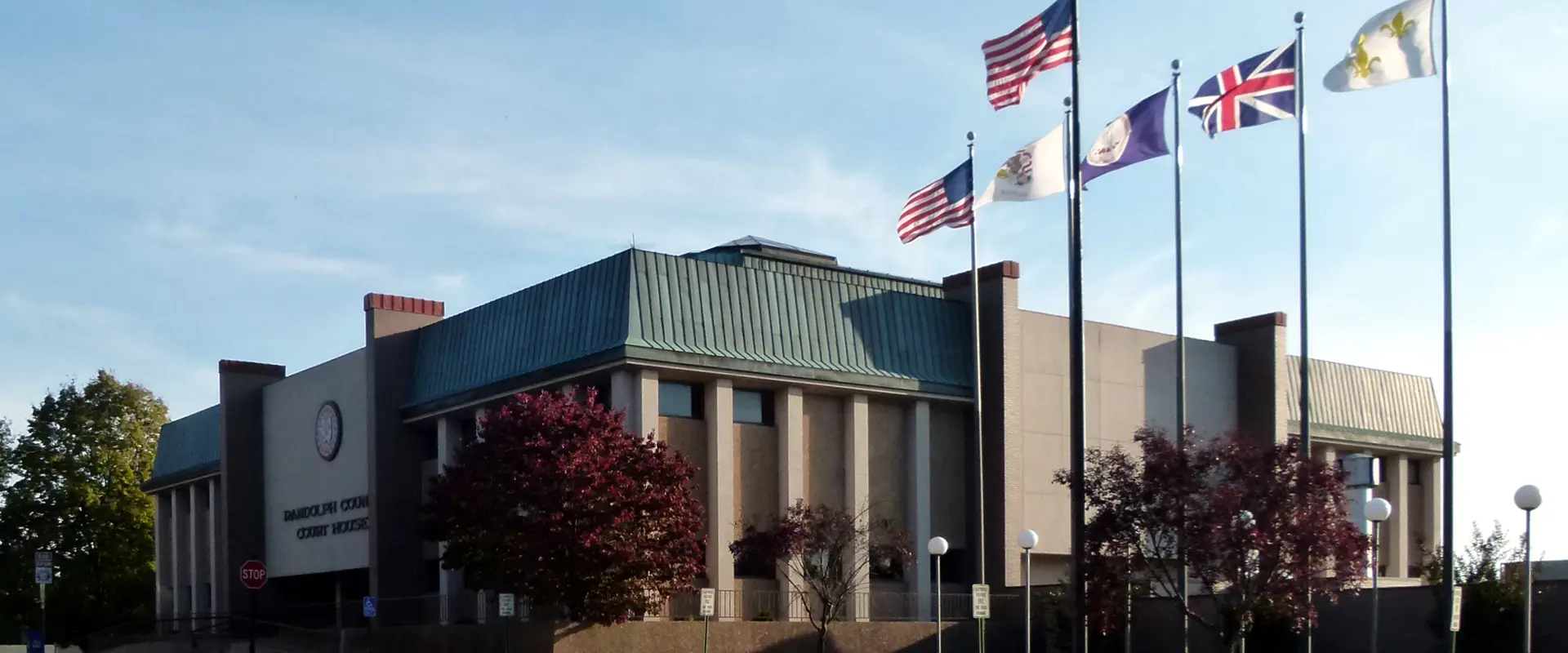
Most court services are available at the Randolph County Courthouse, which houses all circuit court divisions. It is also the center of court administration because it hosts the Circuit Clerk's Office, which is at the frontline of the administration of the courts. Apart from handling filing and record-keeping, it is the first point of contact for people with inquiries about the courts. The staff is always available to provide procedural assistance, but they are not permitted to give legal advice on specific issues.
Types of Courts in Randolph County, Illinois

Randolph County strictly follows the Illinois Unified Court System, meaning it has a single trial-level court that handles everything. The court has been divided into divisions to ensure that all case types are handled in a timely manner. As much as they are all under the Circuit Court, each has its own rules and regulations governing its operations. All court operations are at the Randolph County Courthouse. Below are the divisions and their jurisdictions.
 Criminal Division
When the State of Illinois charges someone with a criminal case in Randolph County, the criminal division of the Circuit Court picks up the matter. Cases handled here range from Class C misdemeanors to Class X felony cases. Specifically, it handles:
- Felony cases
- Misdemeanor offenses
- Preliminary hearings and arraignments
- Bond hearing
- Post-conviction matters
- Traffic-related criminal matters
- Bond hearing
All cases at this division are prosecuted by the State's Attorney, and the sensitivity of the matter would require one to have a lawyer. In case a citizen cannot afford one, they are at liberty to apply for one.
 Civil Division
Disputes among private parties, including individuals, businesses, and organizations, are handled in the Circuit Court. In most cases, people are looking for monetary compensation or property. Currently, the circuit court handles civil matters involving $10,001 or more. Cases here include:
- Civil cases involving larger amounts
- Property disputes
- Contract claims
- Personal injury lawsuits
Unlike criminal cases, these cases do not have a state prosecutor involved; individuals must either hire an attorney or present their case themselves. Rather than proof beyond a reasonable doubt, proof by a preponderance of the evidence takes precedence. It is important to come prepared to avoid losing the case.
 Family and Domestic Relations
Issues affecting families and children at the domestic level are handled by the Circuit Court Family and Domestic Relations Division. It covers:
- Divorce and dissolution of marriage
- Legal separation
- Child custody and parenting arrangements
- Child support
- Order of protection
In Illinois, divorce is a no-fault case, meaning neither spouse needs to provide evidence of wrongdoing to be granted a divorce; irreconcilable differences are enough. Even then, matters like marital property, spousal maintenance, and matters affecting minor children can be a source of contention. It is important to note that the court treats Orders of Protection as emergencies, and one does not need a set court date to get a hearing.
 Probate Division
When a person is deceased, matters involving the division of their property and the payment of their debts are handled in the Circuit Court. This division deals with:
- Estates administration
- Debt payments
- Distribution of assets to heirs and beneficiaries
- Guardianship selection
- Conservatorship determination
When someone dies with a will, the court will oversee the distribution of the estate, while for those who die without one, the court will determine how the estate should be divided. Probate matters may take a long time to resolve because of their sensitivity. It can take even months and years, depending on the size of the estate and whether the will is contested.
 Small Claim Division
As the general civil case with higher amounts being taken at the Circuit Court, small ones with claims that do not surpass the $10,000 threshold are handled at the small claims division. Here, court procedures have been simplified to speed up the process and allow people to access justice without a lawyer. Small claim cases include:
- Unpaid loans between individuals
- Landlord and tenant issues
- Minor property damage claims
- Disputes over goods or services
Filing such cases is handled at the Circuit Clerk's Office and incurs a modest fee.
 Juvenile Division
In Randolph County, Cases involving minors under the age of 18 are handled at the Circuit Court. The division handles two types of cases, which are:
- Delinquency Cases: Involve minors who have been involved in a criminal act and could qualify to go to the criminal division if they were adults
- Dependency Cases: Deals with matters that involve children who have been abused or neglected.
In most cases, records here are not accessible to the public to maintain the privacy of minors. The procedures followed have been designed to rehabilitate the minors, not to punish them. It is important to know that the state allows cases to be handled as adult cases if they involve serious or violent offenses.
How to Access Randolph County Court Records

In Randolph County, most court records are considered public, meaning citizens can freely access them. But some exceptions to the law apply in cases that involve minors, either juvenile or family cases, to protect their privacy. Also, some cases can be sealed by a judge for legal reasons. Accessing court records can be done through several methods, with the most suitable depending on the restrictions and the search information available for the case. Below is a section that describes the available options.
 Online Access
The people of Randolph can easily search for case information using the party's name, case number, and the date the case was filed, and access it through re:SearchIL. The portal is a statewide one that allows people to access case index information from the comfort of their homes. One must be careful not to misspell the name or use the wrong case number when searching to avoid getting null results or incorrect details. If a resident cannot access records online at their home, the county provides kiosks in the courthouse.
 Alternative Online Options
Apart from the official court site, people can access thoroughly researched information through CourtCaseFinder. The portal allows people to conduct a broader search on a single platform instead of visiting multiple sites. It achieves this by aggregating information from different court sites within Illinois and beyond. As much as the information can be trusted, take time to verify the most recent information from the relevant court official website in case there is an update.
 In-Person Requests
Some case records are not accessible from the online platforms. For instance, sealed cases, such as juvenile and some family cases involving minors, are restricted and cannot be accessed online. To get them, an in-person visit to the Circuit Clerk's Office is the most viable option. When visiting, one should carry as much case information about the case as possible. Having details like the case number, the party's name, and the filing date will help streamline the process. Those seeking certified copies should be prepared to pay a modest fee.
 Archived Records
As the volume of case records increases, older court records are moved to specific depositories. For Randolph County, the main custodian is the Illinois Regional Archives Depository (IRAD), which has case files dating back to the 1800s. Randolph County's archived records are housed at Southern Illinois University in Carbondale. To access archived records, residents should first search the site to see whether their case type has been indexed. Once the case record is identified, requests with the party's name and date range are made by mail or phone. The copies are delivered by mail or can be collected in person at an IRAD office.
For Attorneys and Legal Professionals
Illinois requires lawyers to file all civil cases through eFileIL, a statewide eFiling portal for the people of Illinois. Through the site, attorneys can access court records and use additional tools to expand their access. Standing counsel can log in to re:SearchIL and specify their Attorney Registration and Disciplinary Commission (ARDC) number. The credential distinguishes them from ordinary citizens and indicates their user role as law practitioners in Illinois. At the county level, depending on the case they are handling, they can obtain actual transcripts on proceedings, motions, and orders for cases such as arbitration, domain, tax, and magistrate functions.
Before a lawyer proceeds with a court process in Randolph County, they can take time to review the 24th Judicial Circuit local rules and familiarize themselves with them. It addresses a lot of useful things, ranging from motion scheduling to formatting requirements for submitted documents. Having clarity would ensure they avoid petty mistakes that could affect the outcome for their client.
How to File a Case in Randolph County

As much as Illinois allows people to file their cases as self-represented litigants, the process can be frustrating, especially if one lacks knowledge of how to proceed. But it can be much easier if an individual has prior knowledge of the steps to follow when filing. Below are some general steps filers can follow.
 Step 1: Choose the Correct Court
One important thing to do is to ensure that the court in which one files a case is the correct one. In Randolph, all cases are handled at the Circuit Court, making the selection easy. But the court has divisions entrusted with handling specific case types. By identifying the case type, one can determine the specific division mandated to handle the case. The Civil Division handles all cases involving private parties, the Criminal Division takes care of misdemeanor and felony cases, the Family Division takes care of domestic relations issues, the Probate Division handles estates of the dead, and the Juvenile Division takes care of cases whose parties are minors under the age of 18. Choosing the right division is a step towards successful filing. The Circuit Clerk's Office can help residents who aren't sure which division to file with.
 Step 2: Complete Required Forms
After residents obtain the division, the next step is to select the standardized forms that will enable them to file their case. The majority of the civil case forms are available from the state through the Illinois Court Website on the forms page. Also, people can get forms and plain-language guides at the Randolph County Legal Self-Help Center. For those forms not available online, an in-person visit to the Circuit Clerk's Office provides better directions, but not legal advice. Accuracy when filling out the forms is key. Missing information or providing incorrect information can lead to delays or rejection.
 Step 3: File the Case
Nearly all civil cases in Randolph County are filed online through eFileIL. There are a limited number of exemptions that allow some residents to file in person. Once the case is filed, the clerk assigns a case number and stamps the document. When visiting, one should carry more than one copy to ensure that the clerk stamps the documents and keeps one for themselves. The case number is issued at this stage and should be kept safe, as it will be used to track the case going forward.
 Step 4: Pay Filing Fees
When filing a case, the court expects payment of a specific fee that varies by case type. Small claims matters usually have a modest fee compared to those of the general civil issues. One needs to check the fee schedule at the Circuit Clerk's Office before proceeding. If someone cannot afford the fee, they may file an Application to Sue or Defend as an Indigent Person. Those with low income have a higher chance of qualifying.
 Step 5: Serve the Other Party
In Illinois, a case-filing process is not considered complete if the other party is unaware of the lawsuit. Service of process should be conducted legally to avoid rejection. In Illinois, the service documents are prepared with the Circuit Clerk and the Sheriff's office, which delivers them at a cost. Also, the private process server or certified mail can be another option. Once done, a proof of service must be filed back with the court for the case to proceed.
 Step 6: Monitor the Case
Finally, having taken every step correctly, the court schedules the appearance dates, which parties must strictly adhere to. Noncompliance may lead to a default judgment, dismissal, or an arrest warrant. Use tools such as re:SearchIL to track the case. It allows the citizens to search for case information like the party's name, docket number, or date range for free, and they get access to index information about the case.
Randolph County Courthouse Directory
Because of the unified court structure, Randolph has a single courthouse that houses all Circuit Court divisions and the Circuit Clerk's office. For this reason, the people do not have to visit different locations to seek justice.
Randolph County Courthouse
The courthouse hosts the Circuit Court and its divisions. All the court offices, including that of the Circuit Court Clerk's office, are also housed here.
Chester
Address: 1 Taylor Street, Room 302, Chester, IL 62233
Phone: (618) 826-5000
Website: randolphcountyil.gov/circuit-clerk
Legal Help and Self-Help Resources
The significant number of people who file cases as self-represented litigants creates a need to provide free, local legal resources for the public. Below are some:
 Free Legal Assistance
The people with low income can take advantage of the available resources, such as:
- Illinois Legal Aid Online is a statewide resource with plain-language guides and forms to help self-represented litigants navigate the legal process more quickly.
- Land of Lincoln Legal Aid helps low-income individuals with civil matters, including family law and housing, in central and southern Illinois.
- The Illinois Court Help program is designed to help people navigate the court system by providing county-specific information, including court locations, hours, and links to resources.
 Local Legal Support
There are also local support services closer to residents in Randolph County. They include:
- The Illinois State Bar Association can connect individuals with local attorneys at a reduced initial fee.
- The Randolph County Legal Self-Help Center has plain language guides and forms to help people navigate the court processes and self-represented litigants.
- The Center for Disability and Elder Law (CDEL) helps individuals dealing with elder law issues, guardianship, or Medicare-related legal concerns by offering legal help.
FAQs
How can residents obtain court records in Randolph County?
There are two methods that residents can use to get court records. One way is online access through the re:SearchIL provided by the state. They can start the search using the party name or case number to access the case index information. The other option is to visit the Circuit Clerk's Office and describe the case for fast-tracking.
How does someone get a fee waiver to file a court case in Randolph County?
To obtain a fee waiver when filing a case, one must submit the Application to Sue or Defend as an Indigent Person along with the other filing documents. The application will require transparency in the financial statements to help the judge determine if an applicant qualifies. Those with low income have a higher chance of qualifying.
Can one get a court record expunged or sealed in Illinois?
A lot is taken into account when determining whether the case should be sealed or expunged. According to Illinois, 20 ILCS 2630/5.2 sets out rules that help determine whether a case qualifies. Some cases, like misdemeanor convictions, do not qualify for expungement but can be eligible for sealing after a long wait. Take time and read through to determine qualifications.
What is the difference between the 24th Judicial Circuit and the Randolph County Circuit Court?
The difference lies in the level of operation. The 24th Judicial Circuit is an administrative body for Randolph, Monroe, Washington, and Perry Counties, while the Randolph County Circuit Court is a court within the circuit that handles all trial-level cases in the county. They each have their own courthouses but share the same rules and administration.
When is it helpful to use a third-party records finder?
Third-party tools like CourtCaseFinder offer an alternative to accessing court records to the people of Randolph County. The tool aggregates information from various court sites across Illinois and beyond, putting it in one place for broader search. The tool is very useful for people who are unsure which court a case was filed in.
Other Counties in Illinois
- Adams
- Alexander
- Bond
- Boone
- Brown
- Bureau
- Calhoun
- Carroll
- Cass
- Champaign
- Christian
- Clark
- Clay
- Clinton
- Coles
- Cook
- Crawford
- Cumberland
- Dekalb
- Dewitt
- Douglas
- Dupage
- Edgar
- Edwards
- Effingham
- Fayette
- Ford
- Franklin
- Fulton
- Gallatin
- Greene
- Grundy
- Hamilton
- Hancock
- Hardin
- Henderson
- Henry
- Iroquois
- Jackson
- Jasper
- Jefferson
- Jersey
- Jo Daviess
- Johnson
- Kane
- Kankakee
- Kendall
- Knox
- La Salle
- Lake
- Lawrence
- Lee
- Livingston
- Logan
- Macon
- Macoupin
- Madison
- Marion
- Marshall
- Mason
- Massac
- Mcdonough
- Mchenry
- Mclean
- Menard
- Mercer
- Monroe
- Montgomery
- Morgan
- Moultrie
- Ogle
- Peoria
- Perry
- Piatt
- Pike
- Pope
- Pulaski
- Putnam
- Richland
- Rock Island
- Saint Clair
- Saline
- Sangamon
- Schuyler
- Scott
- Shelby
- Stark
- Stephenson
- Tazewell
- Union
- Vermilion
- Wabash
- Warren
- Washington
- Wayne
- White
- Whiteside
- Will
- Williamson
- Winnebago
- Woodford
Table of Contents
