Table of Contents
Madison County Courts, IL *

Madison County is located in southwestern Illinois on the Mississippi River within the St. Louis, Missouri metropolitan area. Edwardsville is the county seat, with Alton and Granite City also within its borders. The Madison County courts are part of the Third Judicial Circuit and handle criminal, civil, family, probate, traffic, and small claims cases.
Court records are commonly used for background checks, tenant screening, employment checks, and genealogy research. Because of the county's size and activity, understanding the court structure and record locations is important for conducting an effective search.
Overview of the Madison County Court System
The court system in Illinois has three tiers. The Supreme Court of Illinois is the highest court; the Illinois Appellate Courts are in the middle; and the Circuit Courts are the lowest level, with virtually all cases originating here. At the county level, the Madison County trial court is the Madison County Circuit Court, part of the Third Judicial Circuit. It serves Madison County and the smaller Bond County to its east. This is a very large court, with eight Circuit Judges and over a dozen Associate Judges.
The Circuit Clerk is an important office in Illinois, as it maintains most of the files for cases heard by the Circuit Court. This includes the bulk of the files for criminal, civil, family, probate, traffic, and small claims cases and handles the collection of fines and fees for the court. This makes research easier because most records can be found in a single place. A few records, such as those for deeds and marriage licenses, are kept in the County Clerk and Recorder's office in an administrative building next door, so one must determine which office is correct before inquiring.
Types of Courts in Madison County, Illinois

Illinois's system does not divide its trial courts into separate probate, family, and municipal courts. Instead, there is only one type of trial court, the Madison County Circuit Court, which processes all case types and organizes its work into divisions. In larger counties like Madison County, the court's work must be housed in more than one building; however, all work flows through the Circuit Clerk's Office.
The Madison County Circuit Court is the county's only trial court and has general jurisdiction, meaning it hears all classes of cases, from traffic offenses to felonies. Most functions are conducted in the Madison County Courthouse in Edwardsville, but criminal cases are held at the Criminal Justice Center adjacent to the courthouse, and some services are offered at a satellite office in Alton.
Jurisdiction includes:
- Felony and misdemeanor criminal cases
- Traffic tickets and DUI cases
- Small claims for amounts up to $10,000
- Evictions and landlord-tenant disputes
- Divorce, custody, and support cases
- Larger civil lawsuits, foreclosures, and estate cases
- Guardianship of minors and disabled adults
The courts are divided into divisions, such as Criminal, Civil, Family, and Traffic Divisions. The Clerk of the Circuit Court manages all these cases. The county of Madison is particularly famous for its civil division, as it has handled extensive mass-tort cases, including asbestos litigation from around the country, for many years. However, there is no different system for finding these records compared to other civil cases.
 Criminal Division
The Circuit Court's Criminal Division conducts all felony and misdemeanor prosecutions in the county. Since 2004, it has been housed at the Criminal Justice Center in Edwardsville, a short distance from the main courthouse, not at the courthouse itself.
Jurisdiction includes:
- Felony prosecutions
- Misdemeanor cases
- Preliminary hearings and arraignments
- Bond and pretrial matters
It is part of the one Circuit Court, not a separate court. Its files are still maintained by the Clerk of the Circuit Court.
 Civil Division
The Civil Division handles the county's non-criminal disputes, and it is based at the Madison County Courthouse in Edwardsville. This is the division Madison County is nationally known for, since it has long been a center for asbestos and other mass-tort litigation, but it covers a far wider range of everyday civil matters. Probate, the handling of wills and estates, is managed within this division rather than in a separate court.
Jurisdiction includes:
- Personal injury, product liability, and contract disputes
- Small claims for up to $10,000
- Evictions and landlord-tenant disputes
- Foreclosures and large civil lawsuits
- Probate of wills, estates, and guardianships
 Family Division
The Family Division handles domestic and juvenile matters, and it is located at the Madison County Courthouse in Edwardsville. In addition to divorce and support matters, this division also handles juvenile cases, which in many states sit in a separate court but in Illinois fall under this division.
Jurisdiction includes:
- Divorce, custody, visitation, and child support
- Orders of protection and civil no-contact orders
- Adoption and paternity
- Juvenile delinquency, neglect, and abuse
 Traffic Division
The Traffic Division handles a high volume of cases each year, including traffic tickets and citations issued by state, county, and municipal law enforcement agencies throughout Madison County. The division operates through the Circuit Clerk at the courthouse, and many minor matters can be resolved without a court appearance.
Jurisdiction includes:
- Traffic citations and DUI cases
- Misdemeanor charges
- Municipal ordinance violations
- Conservation violations
 Specialty Courts
The Madison County Circuit Court uses problem-solving courts based on a treatment-and-supervision model rather than a traditional sentence. The problem-solving programs are not a separate court; they are part of the standard criminal court system maintained by the Circuit Clerk. The problem-solving courts currently in use are the Drug Court, the Mental Health Court, and the Veterans Treatment Court, each serving distinct eligible populations.
- Drug Court: Handles cases associated with substance abuse problems, such as possession of a controlled substance, larceny or shoplifting, fraud or forgery crimes, criminal damage to property, and prostitution cases.
- Mental Health Court: Handles cases of individuals with severe mental illness in felony and misdemeanor cases, and post-plea defendants who are participating in court-supervised treatment are also served.
- Veterans' Treatment Court: Assists eligible veterans and service members in felony and misdemeanor cases, as well as probation or parole cases, that require court-supervised treatment and services.
How to Access Madison County Court Records

The majority of the Madison County court documents are public under the Illinois Clerk of Courts Act. There are exceptions, such as juvenile cases, adoption, mental health cases, and sealed cases, in which sensitive information would be redacted. Court records can be searched online and by requesting documents at the courthouse.
 Online Access
In contrast to many Illinois counties, which use a joint service, Madison County has its own Court Records Search via the Circuit Clerk's web page. A search by name or case number returns results for civil, criminal, traffic, and other case types. The Madison County Circuit Clerk's web page is the best starting point as it contains links to the court records search, fee information, and payment options.
Illinois also has re:SearchIL, which centralizes documents from the state's electronic filing system. The court system's access policy is the Illinois Remote Access Policy. The general user must register to obtain access. However, an attorney or party to a case will get the most access. The State eServices hub consolidates searching, filing, and case management into one location.
 Alternative Online Options
The official tools work best when someone has some idea of what to search for. An individual armed with just a name, uncertain whether a lawsuit was filed in Madison County or a bordering county in the metro area, would have to search each county individually. CourtCaseFinder offers a solution to this problem by searching multiple jurisdictions at once and identifying the county and court where the record is maintained, a helpful first step before requesting an official copy from the Circuit Clerk.
 In-Person Requests
To obtain a certified copy or an older file not available online, the Circuit Clerk's Document Storage and Record Search Counter is located on the first floor of the Madison County Courthouse in Edwardsville. Clerks will pull the record, verify whether it is available for release, and then issue the certified copy for a fee set by law. Providing information such as full names, estimated dates, and case numbers will make the search easier. Anyone unsure where to begin can contact Illinois Court Help by phone or text for free.
 Archived Records
Madison County has records dating back to 1813, and the oldest are only on paper. Some are located in a storage facility at the courthouse, so retrieving them may take extra time. Most of Madison County's historical material is also held in the Illinois Regional Archives Depository system, which keeps Madison County records at Southern Illinois University in Carbondale. For genealogy or old land records questions, it should include inquiries into Circuit Clerk records and archival records.
For Attorneys and Legal Professionals
Attorneys working cases in Madison County will search the Circuit Clerk's online case status database. Civil cases must be filed through the Illinois eFileIL system and approved service providers, which transmit the documents to the Circuit Clerk's office. Madison County can use a multi-vendor e-filing system because it handles a very large civil caseload. Filing rules differ for criminal and traffic cases, so it is best to verify which method to use to avoid having filings rejected.
Lawyers must file electronically, as the Illinois Supreme Court requires. The paper-filing option is open only to self-represented litigants, who must still submit a Certificate for Exemption from E-Filing. All filings must comply with Illinois Supreme Court Rules and the Local Rules for the Third Judicial Circuit. Since the circuit includes both Madison and Bond counties, attorneys working on cases in both counties should check each county's scheduling and appearance rules. Certified and archived records, in the case of older estate cases maintained on paper, may require additional processing time.
How to File a Case in Madison County

Filing a case and searching records are two different things, but both are performed by the Circuit Clerk. If a case is filed in the wrong division or is not completed correctly, the filing process will be delayed, or the case will be dismissed. The following is the typical filing process for civil cases. Most criminal cases start with the police agency and the State's Attorney.
 Step 1: Choose the Correct Court
There is one court that hears all cases, so one should first determine which division the case belongs to. The Small Claims Division deals with disputes of $10,000 or less. The Civil Division handles all disputes over money over the Small Claims limit. Disputes over a divorce or child custody are handled by the Family Division, and estates or wills are handled by the Civil Division. The venue is the next thing to determine. Generally, a suit must be filed in the county where the defendant resides or where the dispute arose. Residents who have questions about jurisdiction can contact the Circuit Clerk.
 Step 2: Complete Required Forms
Once the court division is set, the next step is the paperwork. Illinois publishes standardized statewide forms for many types of cases, and the Circuit Clerk keeps some forms in the office. Free guides and ready-made forms are also available through Illinois Legal Aid Online, which walks a person through each question step by step. Each form should be filled out clearly, signed where required, and accompanied by every supporting document. A missing piece of information or form is the most common reason a clerk returns a filing.
 Step 3: File the Case
The majority of civil cases are e-filed through an eFileIL provider. There are situations in which a self-represented filer qualifies for an exemption and can submit a paper filing, but they must file an exemption from electronic filing, except in rare cases. Regardless of whether the filing is made on paper or electronically, the clerk will examine the filing, and the filer should hold on to the case number and the file-stamped copy, as both will be used to track the case.
 Step 4: Pay Filing Fees
Fees will vary depending on the case type and can change. It is advisable to call the Circuit Clerk and ask how much a specific type of case costs before filing. If one cannot afford the cost, there is a fee waiver process through which they can file an Application for Fee Waiver for a judge to review based on their financial need. The fee waiver should be filed with the case.
 Step 5: Serve the Other Party
Once the case is filed with the court, the other party must be formally notified of the lawsuit. This is called service of process, which is done through the county sheriff's office, by a special process server appointed by the court, or by certified mail, where permitted by court rule. A filer can't personally serve the other party in civil cases. Proof of service must be returned to the court file; without it, the case may be delayed or dismissed entirely.
 Step 6: Monitor the Case
After service, it is the filer's responsibility to stay current. Court dates and deadlines can change, and missing a civil hearing can result in a default judgment. Checking the docket through the Circuit Clerk's online search or contacting the Circuit Clerk's office directly helps avoid surprises and keeps the case on track from one court date to the next.
Madison County Courthouse Directory
Madison County Courthouse
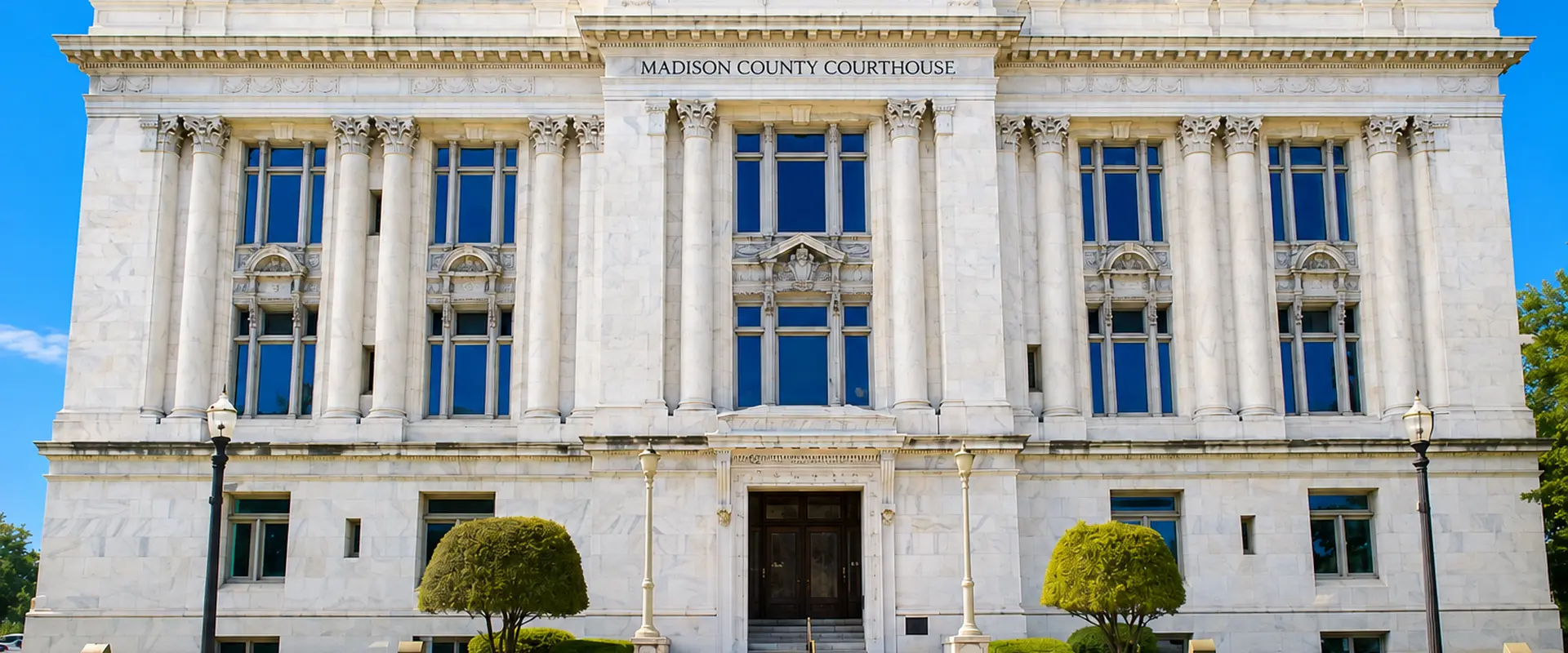
The Edwardsville courthouse houses the Circuit Court and the Clerk of the Circuit Court. This office is responsible for criminal, civil, family, probate, traffic, and small claims case records, as well as receiving case filings, collecting costs, and issuing certified copies.
Criminal Justice Center
Houses the Criminal Division of the Circuit Court and the specialty treatment courts. It is a courthouse and not a stand-alone records office. Criminal records are kept with the Circuit Clerk.
Edwardsville
Address: 509 Ramey Street, Edwardsville, IL 62025
Criminal Division: (618) 692-8932
Specialty Courts: (618) 692-8961
Legal Help and Self-Help Resources
An individual does not have to face a legal issue in Madison County alone. Assistance is available for individuals who can't afford legal counsel.
 Free Legal Assistance
Land of Lincoln Legal Aid serves Madison County residents from its Alton location. It provides free civil legal assistance to low-income eligible residents and seniors on housing issues, including evictions, family law matters such as guardianship, and public benefits. It also assists domestic violence victims in securing orders of protection in Madison County. The statewide service, Illinois Legal Aid Online, offers free information, legal self-help, and guided-form tools for everyone. In an emergency involving personal safety, Oasis Women's Center in Alton provides shelter, counseling, and advocates who assist survivors in the order of protection process.
Specific groups of people receive services tailored to their unique needs. For instance, veterans, surviving spouses, and their dependents have access to assistance through the Madison County Veterans' Assistance Commission, which helps with benefit applications and claims. Seniors and individuals with disabilities can contact Senior Services Plus in Alton for benefit advising and assistance, as well as other services for court issues, including guardianship and estates.
 Local Legal Support
Those without attorneys can access Illinois Court Help, which is a free, statewide resource that answers questions by phone or text about court procedures and provides standardized forms published by the Illinois Supreme Court. Clerk's office personnel can clarify how a procedure is conducted or help one find the correct form; they cannot provide legal advice. The Illinois State Bar Association provides a referral service for residents in cases that require an attorney, matching people with attorneys based on the area of law.
FAQs
Are Madison County's asbestos lawsuit records available to the public?
Yes. Madison County has long been one of the country's most active courts for asbestos and other mass-tort claims, with parties filing from far outside Illinois. These are regular civil matters on the public docket and can be obtained by searching the Court Records Search online or in person with the Circuit Clerk, just like all other civil cases.
Where are records kept for cases heard at the Criminal Justice Center?
With the Circuit Clerk's office in Edwardsville. The Criminal Justice Center on Ramey Street holds criminal and specialty treatment court proceedings, but there is no records room located there. All of the files are held at the main courthouse and filed by the Clerk of the Circuit Court. All record requests begin with the Clerk.
Why does Madison County's court record search work differently from other counties in Illinois?
Most counties in Illinois have their dockets available through a centralized service statewide. However, Madison County has its own Court Records Search system. Searching by name or case number displays results in civil, criminal, traffic, and other types of cases. Results only indicate digitally available records. Documents for e-filed cases are then further managed through re:SearchIL under the Illinois Remote Access Policy through registration.
Who keeps marriage licenses, deeds, and birth records in Madison County?
Not the courts. Those come from the County Clerk and the Recorder. Both offices are located in the county's Administration Building rather than the courthouse. This can be very confusing because these offices are located side by side in downtown Edwardsville. Anyone seeking a marriage license, deed, or a vital record would visit these offices, while divorce or probate cases, among others, are filed with the Circuit Clerk.
Where should a search begin when only a name is known, and the correct county is unclear?
This happens frequently in the metro-east since Madison County borders several counties and is right across from Missouri. A case involving someone in the metro-east could belong to any number of jurisdictions. Searching each county system individually is not only time-consuming, but it could also miss older paper files altogether. A site such as CourtCaseFinder searches multiple courts simultaneously and reveals the court and county where the record is held.
Other Counties in Illinois
- Adams
- Alexander
- Bond
- Boone
- Brown
- Bureau
- Calhoun
- Carroll
- Cass
- Champaign
- Christian
- Clark
- Clay
- Clinton
- Coles
- Cook
- Crawford
- Cumberland
- Dekalb
- Dewitt
- Douglas
- Dupage
- Edgar
- Edwards
- Effingham
- Fayette
- Ford
- Franklin
- Fulton
- Gallatin
- Greene
- Grundy
- Hamilton
- Hancock
- Hardin
- Henderson
- Henry
- Iroquois
- Jackson
- Jasper
- Jefferson
- Jersey
- Jo Daviess
- Johnson
- Kane
- Kankakee
- Kendall
- Knox
- La Salle
- Lake
- Lawrence
- Lee
- Livingston
- Logan
- Macon
- Macoupin
- Marion
- Marshall
- Mason
- Massac
- Mcdonough
- Mchenry
- Mclean
- Menard
- Mercer
- Monroe
- Montgomery
- Morgan
- Moultrie
- Ogle
- Peoria
- Perry
- Piatt
- Pike
- Pope
- Pulaski
- Putnam
- Randolph
- Richland
- Rock Island
- Saint Clair
- Saline
- Sangamon
- Schuyler
- Scott
- Shelby
- Stark
- Stephenson
- Tazewell
- Union
- Vermilion
- Wabash
- Warren
- Washington
- Wayne
- White
- Whiteside
- Will
- Williamson
- Winnebago
- Woodford
Table of Contents
