Table of Contents
Hamilton County Courts, IL *

Hamilton County is in the southernmost part of Illinois, which locals refer to as "Little Egypt" because it lies near the Ohio and Mississippi River floodplain and because the local indigenous mounds reminded settlers of Ancient Egypt. The county seat and largest city within it is called McLeansboro. Its courts are part of the Second Judicial Circuit and are responsible for all criminal, civil, family, probate, traffic, and small claims actions occurring within the county boundaries. The records these actions create are what many people search for, whether for confirmation of a ruling, a background check, or to track down family history.
There are a variety of people who access court records in Hamilton County, from landlords who use them to run a check on prospective tenants to employers who want to check on an applicant before hiring to genealogists who study probate and naturalization files dating back to the county's founding in 1821. Illinois's court structure differs from that of many other states, so understanding where to go and which office holds the records residents are looking for can definitely save time.
Overview of the Hamilton County Court System
Illinois maintains a unified court system made up of a Supreme Court, Appellate Court, and Circuit Courts. Hamilton County is part of the Second Judicial Circuit, and the vast majority of trial-level cases are heard in the Hamilton County Circuit Court.
The Clerk of the Circuit Court is the official custodian of most court records, including criminal, civil, probate, family, traffic, and small claims records. This simplified record-keeping system requires the researcher to look in only one place, as opposed to states where records are housed in several locations. Records not held in the court system include land records and marriage licenses, which can only be accessed by the County Clerk and Recorder.
Types of Courts in Hamilton County, Illinois

The single Circuit Court of Hamilton County manages a wide variety of cases, each having its own corresponding records. The breakdown below reflects the types of cases handled by the Circuit Court and provides brief explanations of their classifications, helping researchers understand what to look for and filers determine where to file a case.
 Circuit Court
Hamilton County has only one court: the Hamilton County Circuit Court. The court has general jurisdiction, so it handles all types of cases, ranging from a traffic citation to a controversial estate case. The Hamilton County Circuit Court is located in the Hamilton County Courthouse in McLeansboro.
Jurisdictions include:
- Felony and misdemeanor criminal prosecutions
- Traffic citations and DUI cases
- Small claims for amounts up to $10,000
- Evictions and landlord-tenant disputes
- Divorce, custody, and support matters
- Larger civil lawsuits and foreclosures
- Probate of wills and administration of estates
- Guardianship of minors and disabled adults
Although court cases are separated by division (Criminal, Civil, Family, and Probate), court files for these cases are all funneled through the Clerk of the Circuit Court. The probate files kept by the Clerk date back to the county's early days, and this office also maintains the naturalization records, which residents can view in person or request copies by mail.
Since the Second Judicial Circuit covers Hamilton County, the Drug Court Program is also available for some cases throughout the circuit. This is another one of the problem-solving court alternatives that deal with cases using supervised treatment rather than jail, where applicable. This is not a separate court or records office, since the cases follow regular court channels at the courthouse.
How to Access Hamilton County Court Records

Records for Hamilton County Courts are generally public records under Illinois Law, except for Juvenile records, adoptions, mental health records, sealed records, and certain confidential records. Most public records are accessible through our website or through the office of the Circuit Clerk.
 Online Access
For typical everyday case lookups, Hamilton County participates in re:SearchIL. This is the standard statewide online service that most counties in Illinois utilize to search cases by name or case number. Access to the entire contents of documents is subject to the Illinois Remote Access Policy and usually requires registration. Legal parties or attorneys to an e-filed case will have full access. The state eServices portal is intended to bring all these resources together. It covers civil, criminal, traffic, and other cases. The Hamilton County Circuit Clerk's web page is a useful local starting point.
 Alternative Online Options
Official records systems are exhaustive but not necessarily the most convenient place to start, especially if a researcher knows a name but not whether a case was filed in Hamilton County or one of the other eleven counties comprising the Second Judicial Circuit. Searching for the same name across multiple county systems is tedious. A commercial aggregator, like CourtCaseFinder, collects public records from numerous disparate sources so it can provide the county and court of location for a file before a person asks the Circuit Clerk for an official record.
 In-Person Requests
Certified copies and older records require a visit to the Circuit Clerk's Office at the Hamilton County Courthouse in McLeansboro. A clerk will help locate records, determine whether they are public records that can be shared with the community, and, if so, prepare a certified copy for a copying fee. Providing a case number and/or complete names with approximate dates will help speed up the research.
 Archived Records
Hamilton County's history can be traced back to its establishment in 1821, and the oldest of the county's records survives only on paper. Some archived records are maintained at the courthouse, but many of Hamilton County's older records are housed within the Illinois Regional Archives Depository system. Hamilton County's physical documents are held at Southern Illinois University in Carbondale. Since the documents have not been digitized, retrieving this material may require additional time and a written request. For historical property inquiries, whether long-past or genealogy-related, it's best to consult the Circuit Clerk's records alongside archival sources.
For Attorneys and Legal Professionals
Hamilton County counsel runs research and status checks through re:SearchIL. With very few exceptions, electronic filing in all civil cases throughout Illinois is required by the Illinois Supreme Court and is done via the eFileIL system, with filings routed to the Circuit Clerk through an approved e-filing service provider. Criminal, traffic, and some quasi-criminal proceedings have separate avenues, so legal professionals should confirm which to use for a specific case type before filing to avoid rejection.
An e-filing system user who is unable to comply may file a paper filing upon completing and submitting a Certificate for Exemption from E-Filing under Supreme Court Rule 9(c)(4). All filings must comply with the Illinois Supreme Court Rules and applicable Second Judicial Circuit-approved local forms. An attorney appearing in more than one of the circuit's 12 counties should investigate the separate schedules and appearance rules in each county. Certified and archive record requests, and especially ancient paper estate file requests, should have a separate processing time.
How to File a Case in Hamilton County

Filing a suit is more complex than locating a file, although both processes go through the Circuit Clerk. If a case is filed in the wrong division or the file does not contain the necessary papers, the case can get bogged down, cost more money, and could even be dismissed. Below are the steps of the normal flow of a civil filing. Criminal filings have their own path, which most commonly starts with law enforcement and the State's Attorney.
Step 1: Choose the Correct Court
Both civil and criminal cases are heard in the Circuit Court, so the first step is choosing the correct division. Small claims cases are suits about money up to the statutory maximum amount of $10,000. Larger cases are handled by the Civil Division; divorce and custody are heard by the Family Division. Estates of deceased residents do not have a separate division within the Circuit Court; they are handled instead by the Civil Division.
The proper venue for a case is another important factor to determine. The venue is normally the county where the defendant resides or where the cause of action arose. Failure to select a proper venue at the filing stage will result in either a transfer or a dismissal later. Residents can always ask the Circuit Court Clerk for clarification.
 Step 2: Complete Required Forms
Once the division has been determined, the next thing is getting the paperwork right. Illinois creates standardized court forms for common types of cases, and the Second Circuit also provides approved forms. Forms and simple guides are also available on Illinois Legal Aid Online. Every form should be signed, filled out legibly, and filed with any required supporting documents. Failing to do so is the most frequent cause for denial of a filing. People who have questions can contact the Circuit Court Clerk.
 Step 3: File the Case
Most civil cases must be filed electronically with an eFileIL service provider from home, at the office, or on a public computer. A self-represented party who qualifies for an exemption may file a paper case in the Circuit Clerk's Office. In either instance, the clerk must accept and process the filing, and it is important to retain the assigned case number and file-stamped copies, as they are needed to track the case, access court records, and verify that documents were properly filed.
 Step 4: Pay Filing Fees
The fee amounts vary by case type and may change. It is important to ask the Circuit Clerk for the most up-to-date filing fee amount before filing the case. If a filer cannot pay the fee, they can apply for a fee waiver using the state's standardized application forms. With the application, one can ask the court to waive or reduce the fees due to one's financial situation. The court must review the application, and a judge must approve it before filing fees can be waived. A filer already on public assistance or with income below a certain threshold has the strongest argument for a waiver.
 Step 5: Serve the Other Party
Once filed, the other party must be formally notified of the case by service of process. This is done by a county sheriff or by a court-appointed private process server. The filer normally cannot serve the documents themselves. It is critical that proof of service of the papers be filed with the court; otherwise, the case will likely not move forward.
 Step 6: Monitor the Case
The filer is responsible for keeping abreast of developments once service is complete. Court dates and time limits are not fixed. Checking the docket with the Circuit Clerk avoids missed court dates, which could result in a default judgment against the party in a civil proceeding. Before each hearing, reading any new filings in the case and gathering the documents and evidence needed for that date helps the filer stay prepared as the case moves forward.
Hamilton County Courthouse Directory
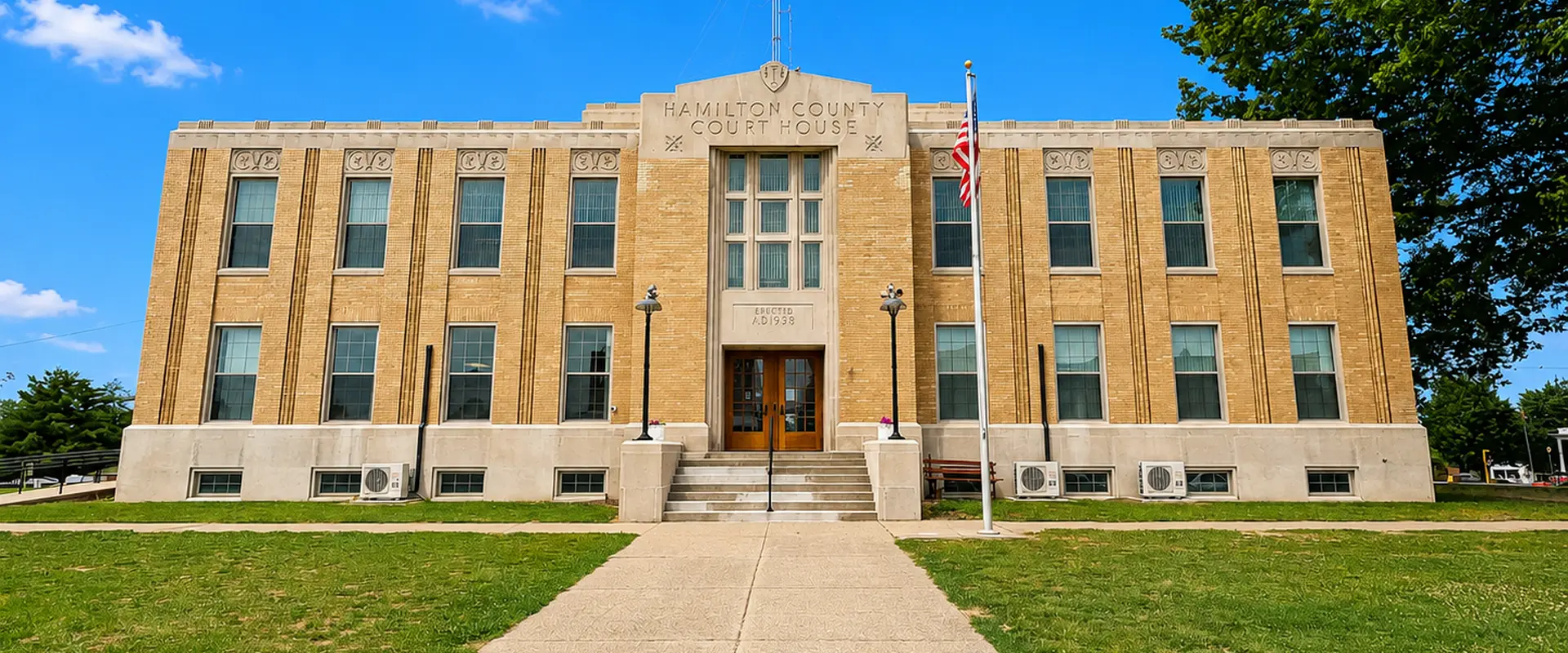
Hamilton County Courthouse
The old Art Deco courthouse of McLeansboro was built in 1938 and is the focal point for county court proceedings. It is the home to the Hamilton County Circuit Court and the Office of the Clerk of the Circuit Court, which keeps criminal, civil, family, probate, traffic, and small claims records, accepts court filings, and issues certified copies of court documents.
McLeansboro
Address: 100 South Jackson Street, McLeansboro, IL 62859
Phone: (618) 643-2611
Website: Hamilton County Courthouse
Legal Help and Self-Help Resources
Help is available from many sources in Hamilton County, not just for those who cannot afford legal representation. Veterans, the elderly, victims of domestic violence, or any person with a complex issue has access to these services.
 Free Legal Assistance
Land of Lincoln Legal Aid provides free civil legal assistance to low-income and elderly people in central and southern Illinois, including Hamilton County, in matters of housing, family, consumer, and public benefits. Illinois Legal Aid Online provides free legal information, guided forms, and self-help tools statewide. For those in a domestic violence situation, the organization Stopping Woman Abuse Now serves Hamilton County and 15 other counties with a crisis shelter and advocacy for victims of domestic violence, sexual assault, stalking, and trafficking, and assists in obtaining orders of protection.
 Local Legal Support
A useful local resource is the network of Second Circuit Legal Self-Help Centers, an internet-based collaboration among the Circuit Court, circuit clerks, Land of Lincoln Legal Aid, and area libraries. It provides self-represented residents with free access to Illinois legal information and court forms near home, with the Hamilton County Center at the McCoy Memorial Library in McLeansboro. The statewide Illinois Court Help can be reached by phone or text to assist in answering procedural questions. Hamilton County Circuit Court Clerk staff explain procedures or provide guidance on locating a form, but are not able to provide legal advice. Those who prefer to retain an attorney can contact the Illinois State Bar Association's lawyer referral service, which connects residents with a lawyer based on practice area and can provide referrals to attorneys who work at reduced rates or pro bono.
FAQs
How can someone search Hamilton County court records online?
The Circuit Clerk's website will serve as the local entrance for residents. E-filed documents are searched within the statewide re:SearchIL repository; however, full case documents must be registered in accordance with the Illinois Remote Access Policy. Cases that are sealed cannot be viewed.
Does Hamilton County have separate probate, family, and traffic courts?
No. Illinois has one general-jurisdiction Circuit Court, where all case types are heard, divided internally into branches such as criminal, civil, family, and probate. Illinois does not have a separate probate court or a separate municipal court, as some other states do. All records of every branch are kept by a single custodian, the Clerk of the Circuit Court, and are generally easier to locate than in states where records are kept by multiple entities.
Is electronic filing required, and what if someone cannot e-file?
All civil cases must be e-filed on the eFileIL system per the Illinois Supreme Court rules. In Hamilton County, as in all other counties, a case must be e-filed. In cases where a party is unable to e-file, such as a self-represented litigant without internet access or facing a hardship, a Certificate for Exemption from E-Filing per Supreme Court Rule 9(c)(4) can be filed, and the Circuit Clerk will explain how an exemption works.
What is the Second Circuit Drug Court Program?
This is a problem-solving program in all 12 counties of the Second Judicial Circuit, including Hamilton County. It arranges for some of the defendants with cases pending who have substance abuse issues to receive supervised treatment instead of imprisonment. It is not a distinct court or records division, so the case itself still progresses through normal channels at the courthouse, and case records are retrieved in the same manner as for any criminal case.
Where should a search begin when only a name is known, and the county is uncertain?
The Second Judicial Circuit in Hamilton County comprises 12 counties. Therefore, an individual associated with a case in southeastern Illinois could have a file at any of these 12 courthouses. Running the same name across 12 different county systems might take time and likely won't locate an old paper file. A program like CourtCaseFinder searches multiple courthouses simultaneously and indicates which county and court contain the record. This effectively cuts down the scope of the search before requesting certified copies from the clerk.
Other Counties in Illinois
- Adams
- Alexander
- Bond
- Boone
- Brown
- Bureau
- Calhoun
- Carroll
- Cass
- Champaign
- Christian
- Clark
- Clay
- Clinton
- Coles
- Cook
- Crawford
- Cumberland
- Dekalb
- Dewitt
- Douglas
- Dupage
- Edgar
- Edwards
- Effingham
- Fayette
- Ford
- Franklin
- Fulton
- Gallatin
- Greene
- Grundy
- Hancock
- Hardin
- Henderson
- Henry
- Iroquois
- Jackson
- Jasper
- Jefferson
- Jersey
- Jo Daviess
- Johnson
- Kane
- Kankakee
- Kendall
- Knox
- La Salle
- Lake
- Lawrence
- Lee
- Livingston
- Logan
- Macon
- Macoupin
- Madison
- Marion
- Marshall
- Mason
- Massac
- Mcdonough
- Mchenry
- Mclean
- Menard
- Mercer
- Monroe
- Montgomery
- Morgan
- Moultrie
- Ogle
- Peoria
- Perry
- Piatt
- Pike
- Pope
- Pulaski
- Putnam
- Randolph
- Richland
- Rock Island
- Saint Clair
- Saline
- Sangamon
- Schuyler
- Scott
- Shelby
- Stark
- Stephenson
- Tazewell
- Union
- Vermilion
- Wabash
- Warren
- Washington
- Wayne
- White
- Whiteside
- Will
- Williamson
- Winnebago
- Woodford
Table of Contents
