Table of Contents
Grundy County Courts, IL *

Grundy County is located in the northeastern region of Illinois, with Morris as the county seat and largest incorporated city within the county. The county was created in 1841 and named after Felix Grundy, who served as a Tennessee lawyer, U.S. Senator, and U.S. Attorney General between 1777 and 1840. The county has a population of 54,052 as of 2025 and is ranked among the fastest-growing counties in Illinois.
Grundy County Court system operates within the Illinois Judicial system with a single trial court, the County Circuit Court, which presides over all the county's filed cases and operates under the 13th Illinois Judicial District, which is shared with two other counties, Bureau County and La Salle County.
Overview of the Grundy County Court System
The Grundy County judicial system uses the Illinois Unified judicial system, which means the county has a single trial court, the Grundy County Circuit Court. It presides over all the cases filed within the county, with a specialized Criminal and Civil Division, where these cases are heard. These cases are presided over by the Resident Circuit Judge and one Associate Judge, who is assigned by the Chief Judge. As per the Illinois Supreme Court rules, the Associate Judge does not have jurisdiction over felony cases within the county.
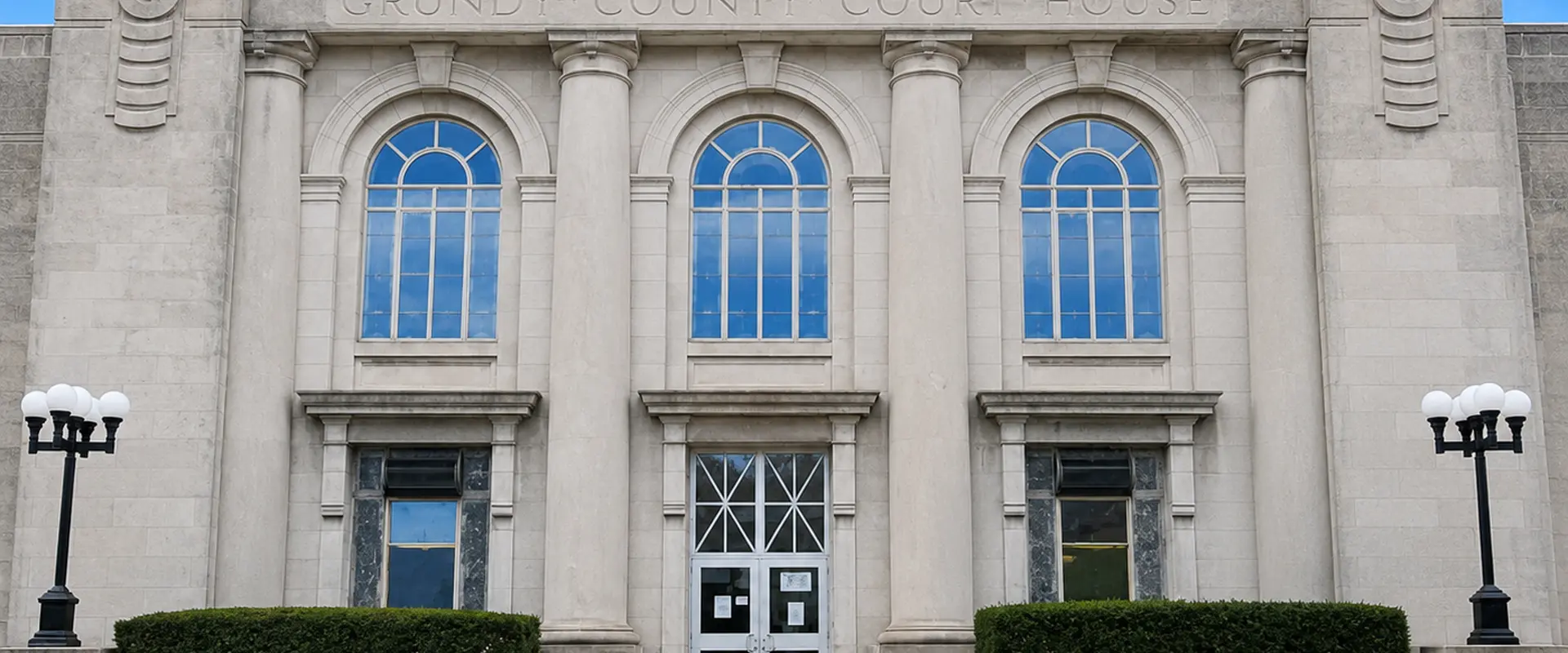
All the County Courts are physically located at the Grundy County Courthouse, where different offices, including the Circuit Court itself, the Circuit Clerk's offices, the Public Defender's office, the State's Attorney's Office, and the courtrooms, are all located.
Types of Courts in Grundy County, Illinois

For the county residents or someone navigating their way through the Grundy County Court system, an overview of the system tends to only give a brief introduction to the overall court operations. A deeper understanding of different types of courts within the county and their responsibilities is provided below.
 Circuit Court
The Grundy County Circuit Court is the county's court of general jurisdiction, a single avenue for all cases filed within the county, and sits within the Illinois 13th Judicial Circuit. It is located within the County Courthouse, where it presides over the following cases:
- Criminal matters
- Civil cases
- Family and domestic legal matters
- Probate and guardianship
- Juvenile matters
- Housing and property cases
The County Circuit Court system operates in divisions that preside over different case types, making it possible for the Circuit Court to effectively preside over all the cases filed within the county. Below is a discussion of these divisions and the cases heard in each of the divisions:
- Civil Division: This division presides over cases such as mortgage foreclosures, name changes, property damage, personal injuries, evictions, tax deeds, small claims, divorce, paternity, estates, and guardianships.
- Criminal Division: This division hears cases involving felonies, misdemeanors, ordinance violations, DUI, juvenile matters, and mental health cases.
How to Access Grundy County Court Records

Most of the court case records in the Grundy County court system are publicly accessible, with a small category of records private. Records such as juvenile case records, adoption records, and mental health records are sealed. This ensures the privacy of the involved parties, including minors, and that health records are protected.
 Online Access
One of the primary ways county residents access court records is online, as it is easy. Residents do not need to visit the courthouse to access court records; instead, they can use the County Clerk's online platform, a multi-county Illinois case search platform that hosts Grundy County Circuit Court case records. The platform gives residents access to civil, criminal, traffic, small claims, family, and probate case records.
 Alternative Online Options
CourtCaseFinder helps residents access cases that go beyond a single county, which are not easily accessible through the state-provided platforms. The platform also helps residents easily find court cases when they are not sure which office holds the case record. This is possible because the platform can fetch case records from multiple public sources into a single search result, making it easier for users to access court records.
 In-Person Requests
Grundy County residents also have the option to physically access the court records by visiting the Grundy County Circuit Court Clerk's office. Here, residents can access physical, certified, and archived case records. When visiting the clerk's office, it is advisable to ask the clerk for help, as they know the case records indexing system used to record and store case files. With their help, residents can easily access case records more quickly.
 Archived Records
Grundy County residents also have access to the county's archived records, which are typically stored in hard copies and on microfilm and have been transferred from the courthouse to the state archive system, Illinois Regional Archives Depository (IRAD). IRAD is a network of seven regional archives managed by the Illinois State Archives and housed on the state university campuses that are responsible for preserving historical local government records. They hold case records such as criminal court case files, chancery, civil cases, docket books, and probate records. Grundy County Archived records are held at the IRAD branch at Illinois State University (ISU).
For Attorneys and Legal Professionals
Out-of-state attorneys appear in Grundy County cases under Illinois Supreme Court Rule 707, the pro hac vice rule, administered by the Attorney Registration and Disciplinary Commission (ARDC). The rule requires that an active-status Illinois attorney must enter an appearance as local counsel of record. The out-of-state attorney must file a verified statement with the ARDC and serve a certificate of good standing from each jurisdiction of admission, and serve the Statement on the ARDC and to all parties.
Attorneys must also understand the local rules of the Grundy County court system that matter most, the motion of practice rules (Part 2), the domestic relations and the family mediation program, and the mandatory Residential Foreclosure Mediation Program (Part 12) operating in the Circuit. Attorneys also need to be aware of the recent changes within the county court infrastructure.
How to File a Case in Grundy County

Filing a case with the Grundy County Court system can be difficult if care is not practiced in the process of filing, which can result in case rejection, dismissal, and wastage of resources such as time and money. All this can be avoided by following the correct case-filing process, which involves the clearly defined steps articulated below.
Step 1: Choose the Correct Court
When someone wants to file a case, they must identify the appropriate court to handle their specific matter. In Grundy County, people do not have to choose a court because the county is unified under a single Circuit Court that handles all trial-level matters. But they are required to choose the division that deals with the specific issue. Specifically, the Civil Division and Criminal Division are the options available. Choosing the right court is the first step toward successfully filing a case.
 Step 2: Complete Required Forms
Once the correct jurisdiction is identified, the next stage is filling in the required information relevant to the complaint. In Grundy Island County, the Circuit Clerk provides a full list of court forms applicable to all divisions. Residents can also get statewide forms from the Illinois Court. The office of the Circuit Clerk also helps residents locate forms if they cannot find them online. The forms can be downloaded and filled out offline. The Circuit Court Clerk's Office can assist residents in ensuring their forms are filled out correctly.
 Step 3: File the Case
After the case forms are completed, the filer proceeds to the next step: the electronic case filing process. E-filing has been mandatory in Illinois civil cases since 2018. Hence, cases are filed through an Electronic Filing Service Provider (EFSP). In Grundy County, filers have access to a few EFSP options, namely Odyssey eFileIL and i2File, which offer free user accounts for filing cases. There are exceptional cases in which individuals can file their cases on paper, but this requires submitting a Certificate for Exception from E-filing, with common grounds including lack of internet access, disability, language difficulties, or filing an order of protection or a civil no-contact/stalking order. Then, the filers must visit the County Circuit Court Clerk's office to complete the paper filing process.
 Step 4: Pay Filing Fees
Filing a case in Grundy County has a filing fee, which varies depending on the type of case and the amount in controversy. The filing fee also includes the Sheriff's service of process charges and the later costs of certified copies, transcripts, or jury fees. The Grundy County Fee Schedule is accessible from the Circuit Court Clerk's Civil Page and is maintained and updated by the Clerk's office. And for filers who cannot afford the case filing fees, they may file an Application for Waiver of Court Fees, asking the court to waive all or part of the filing fees. A judge reviews the application and signs an Order on Application for Court Fee, granting a full waiver, a partial waiver, or denying the application.
 Step 5: Serve the Other Party
Once the case is filed, the defendant must be notified through a process called Service of Process. The filer cannot serve the defendant, so the process is carried out by the Grundy County Sheriff's Civil Process Division. Once the defendant is served, the sheriff's office records a proof of service record with the court. The filer needs to keep a copy of the proof of service, the Certificate of Service, which the court requires before the case hearings can proceed; the lack of these records can result in the case stalling or being dismissed.
 Step 6: Monitor the Case
Finally, the case filing process is complete, and the last step is the filer's monitoring of the case, which requires the case number provided. Filers can monitor their active cases through the Public Case Search portal, accessible directly on the 13th Judicial Circuit's Case Search page. From the platform, the filers are able to monitor the case information, charges, docket entries, case scheduling, all the filings, and the outstanding fees and fines. In Grundy County, filers are also able to monitor their active cases by directly contacting the County Circuit Court Clerk's office, which is in a position to provide up-to-date information on the active case.
Grundy County Courthouse Directory
Grundy County Courthouse
Houses the county Circuit Court of general jurisdiction, which presides over all the county filed cases, which include civil cases, criminal cases, family cases, housing cases, juvenile legal matters, and traffic cases.
Morris
Address: 111 E. Washington Street, Room 30, Morris, IL 60450
Phone: (815) 941-3256 (general)
Civil/Probate: (815) 941-3207
Criminal/Traffic: (815) 941-3260
Child Support/Jury/Wedding: (815) 941-3259
Email: circuitclerk@grundycountyil.gov
Website: Grundy County Circuit Court Clerk
Legal Help and Self-Help Resources
Grundy County residents can access legal aid resources from a mix of service providers, including non-profit organizations, county-provided services, and state-supported platforms, all geared toward helping residents navigate the county court system.
 Free Legal Assistance
Residents who have a low income can take advantage of available resources, such as:
- Illinois Legal Aid Online is a statewide resource with plain-language guides and forms to help self-represented litigants navigate the legal process more quickly.
- The Prairie State Legal Service offers free legal services to qualified residents. Those of low income are more likely to qualify.
- The Access to Justice Commission helps low-income and self-represented litigants have meaningful access to the courts.
 Local Legal Support
There are also local support services closer to residents in Grundy County. They include:
- The Illinois State Bar Association can connect individuals with local attorneys at a reduced initial fee.
- The Illinois Equal Justice Foundation can connect people of low income in Grundy County with appropriate representation from its directory of state-funded legal aid programs in Illinois.
FAQs
How can residents search for court records in Grundy County?
Court records in Grundy can be obtained online and offline. The first option is to use the party name or case number in re:SearchIL to retrieve all cases handled by Illinois courts. The other option is in-person requests at the Circuit Clerk's office. The services are free unless the requester wants copies.
What is the small claims limit in Grundy County?
Grundy County uses the $10,000 limit threshold set by the Illinois Circuit Court. Small claims cases are handled informally and without the need for a lawyer. For major civil matters that exceed the limit, the case will proceed through the general civil docket, which is more formal and has a higher filing fee.
Can I file a court case without an attorney in Grundy County?
Yes. Filing a case without a lawyer is permitted in Illinois, and the filers are known as pro se parties. The practice is commonly used in small-claims cases, which do not require a lawyer. The cases are conducted informally, allowing the parties to argue their own cases. The litigants get standardized forms from the Illinois Court Website at the forms page.
Can I request an interpreter?
Yes, it is possible to get an interpreter in Illinois courts, which provides free sign-language and spoken-language interpreters for every Circuit Court; this includes the Grundy County Circuit Court. To get this interpreter, one is required to submit an Interpreter Request Form to the Grundy County Circuit Clerk's Office before the hearing. This helps improve the chances of getting the right language match on the date of the case hearing. And the entire process is catered and paid for by the court.
Are online court record searches always accurate?
Court records from searches made through official portals are accurate, but they should be compared with the stamped copies. The sites, including third-party providers, are reliable for broad research. The information obtained can only be used in legal proceedings if the court determines that it aligns with its standards.
How long does it take to get copies of documents from the Circuit Court?
Copied documents are usually completed and available the same day the request was made. If the documents are in the archives or a certified copy is needed, it can take several business days to complete the request. One can contact the Grundy County Circuit Clerk's office for the copying fees list and an estimated time for the records to be ready.
When is it helpful to use a third-party records finder?
Third-party sites are helpful when requesters lack identifying details about the case, such as the party's name or case number. Record finders such as CourtCaseFinder support name-based searches that return all cases that contain the specified keyword. Since the results are nationwide, they can be narrowed to civil, criminal, probate, and family matters heard in Illinois and Grundy County.
Other Counties in Illinois
- Adams
- Alexander
- Bond
- Boone
- Brown
- Bureau
- Calhoun
- Carroll
- Cass
- Champaign
- Christian
- Clark
- Clay
- Clinton
- Coles
- Cook
- Crawford
- Cumberland
- Dekalb
- Dewitt
- Douglas
- Dupage
- Edgar
- Edwards
- Effingham
- Fayette
- Ford
- Franklin
- Fulton
- Gallatin
- Greene
- Hamilton
- Hancock
- Hardin
- Henderson
- Henry
- Iroquois
- Jackson
- Jasper
- Jefferson
- Jersey
- Jo Daviess
- Johnson
- Kane
- Kankakee
- Kendall
- Knox
- La Salle
- Lake
- Lawrence
- Lee
- Livingston
- Logan
- Macon
- Macoupin
- Madison
- Marion
- Marshall
- Mason
- Massac
- Mcdonough
- Mchenry
- Mclean
- Menard
- Mercer
- Monroe
- Montgomery
- Morgan
- Moultrie
- Ogle
- Peoria
- Perry
- Piatt
- Pike
- Pope
- Pulaski
- Putnam
- Randolph
- Richland
- Rock Island
- Saint Clair
- Saline
- Sangamon
- Schuyler
- Scott
- Shelby
- Stark
- Stephenson
- Tazewell
- Union
- Vermilion
- Wabash
- Warren
- Washington
- Wayne
- White
- Whiteside
- Will
- Williamson
- Winnebago
- Woodford
Table of Contents
