Table of Contents
Effingham County Courts, IL *

Nestled in south central Illinois, Effingham County was formally established by law in 1831. However, the act to organize the county wasn't approved by the Illinois legislature until December 20, 1832. The county was named for Thomas Howard, the third Earl of Effingham, an English nobleman and military officer who championed the cause of the American colonists in the years leading up to the American Revolutionary War.
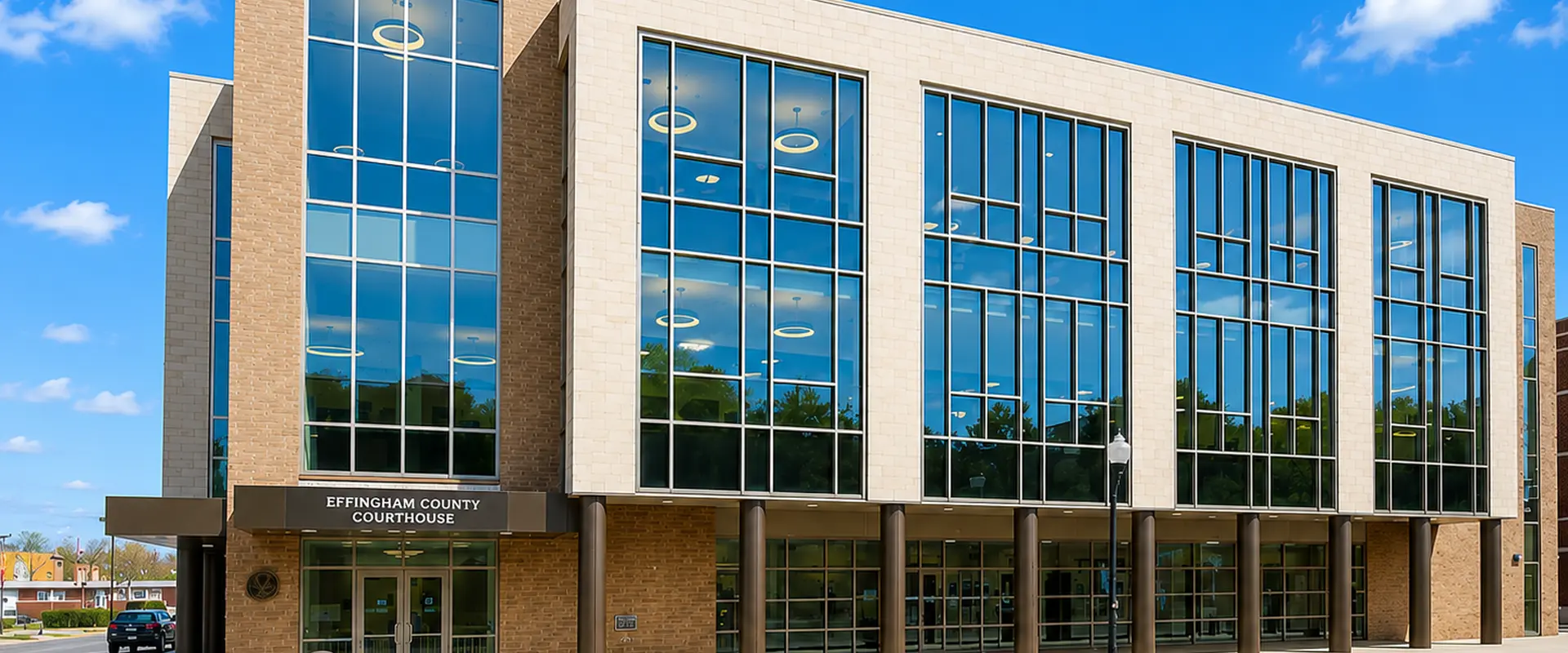
Court activities in Effingham County take place in the county seat, Effingham, where the Effingham County Courthouse is located. This courthouse hosts the Circuit Court, which hears civil, criminal, and traffic cases. It also houses the offices of the Circuit Clerk and County Clerk & Recorder. These two offices maintain court records and public records.
Overview of the Effingham County Court System
Effingham belongs to Illinois's Fourth Judicial Circuit along with the counties of Shelby, Montgomery, Marion, Jasper, Fayette, Clinton, Clay, and Christian. All nine counties operate under a unified judicial system. Nevertheless, each has its own courthouse where its court proceedings are held.
The Fourth Judicial Circuit is served by nineteen judges, twelve of whom are circuit judges, and seven associate judges. Each judge in the circuit can hear cases in any of the counties. They typically receive judicial assignments from the Chief Judge, whom they elect.
Types of Courts in Effingham County, Illinois

Effingham County is served by a single court: the Circuit Court. This is where all cases occurring in the county are processed. The court is divided into several divisions responsible for different cases.
 Civil Division
The Effingham County Civil Proceedings Department deals with civil cases. Its scope includes cases such as:
- Divorce
- Eviction
- Foreclosure
- Guardianship
- Probate
- Small claims
- Mental health
- Family law
 Criminal Division
Criminal cases in Effingham County are heard through the Effingham County Criminal Department. Among the cases it handles are:
- Misdemeanors
- Felonies
- Juvenile delinquency
- Local ordinance violations
- Contempt of court
 Traffic Division
Effingham County deals with traffic offenses through the Circuit Court's Traffic Department. Residents can pay traffic citation fines and find Traffic Safety School forms through this department.
How to Access Effingham County Court Records

Residents of Effingham County can access most court records. The right of access to these records is established under the Illinois Freedom of Information Act (5 ILCS 140). Among the records available for public access are civil and criminal case files, final judgments and court orders, and sentencing records. It's worth noting, however, that certain records, such as those involving minors, are restricted for statutory and privacy reasons. These can only be accessed by authorized persons such as parties involved in the case and their respective attorneys. That said, residents and attorneys in Effingham County have several avenues to obtain court records.
 Online Access
Court records in Effingham County can be retrieved online from re:SearchIL. This online repository and portal hosts court records from participating Illinois Courts. Residents can use the platform to locate case data, such as litigant information, criminal charges and sentences, civil judgments, fines and fees, case minutes, and hearing dates. Users can look up records using details such as party names, case numbers, and filing dates.
 Alternative Online Options
An alternative way to locate Effingham County court records is through third-party sites like CourtCaseFinder. These platforms aggregate court records from multiple counties and compile them into a single database for instant, easy access. Residents of Effingham County often turn to these sites to find court records for civil and criminal cases, traffic violations, divorces, and civil claims. The advanced filters built into these sites also let users search records by party names and jurisdiction.
 In-Person Requests
Public court records in Effingham County can be obtained directly from the office of the Circuit Clerk as long as they haven't been sealed or expunged. Certain records, such as those involving juvenile and adoption cases, are also restricted and may be requested only by authorized persons and petitioners granted permission by the court. Nevertheless, physical and certified copies of most criminal and civil cases are available upon request. Having relevant case details, such as party names and case numbers, makes it easier for the staff at the Circuit Clerk's office to retrieve them.
 Archived Records
Court records for older cases in Effingham County aren't always available online. These records can be requested in person from the Circuit Clerk. That being said, records from the county's early days are accessible only from the state-managed Illinois Regional Archives Depository System. Spread out across seven state university campuses, this system houses archival case files, including probate records, civil and criminal case records, coroner's inquest records, and insanity proceedings records. One doesn't need a written request to access these archived records. But since the archives are hosted on university campuses, it helps to notify them of a planned visit ahead of time.
For Attorneys and Legal Professionals
Most legal experts and attorneys native to Effingham County find it easier to navigate the court system. However, those visiting for legal matters should familiarize themselves with state and local rules to enjoy a seamless experience.
Legal professionals can locate records for past and current cases from re:SearchIL. Having the full names of the involved parties, the case number, and the filing date helps expedite retrieval of the case date. Attorneys can also visit the Circuit Clerk's office for further assistance if they're unable to locate certain records online.
How to File a Case in Effingham County, Illinois

The court system in Effingham County is pretty simple in structure. This makes filing cases here very straightforward. Be that as it may, it still requires adequate preparation and careful attention. It's imperative that one follow the proper procedure right from the start. Doing so facilitates faster case processing. Here's a step-by-step guide on how to handle case filing in the county.
 Step 1: Choose the Correct Court
Effingham County has the Circuit Court as its only trial court. That doesn't mean that all cases are handled similarly. So before filing any case, one must determine whether their matter falls under the court's civil, criminal, or traffic department. Where a case goes affects the forms one must fill out and, ultimately, the filing fees they will pay. Taking time to identify the correct department mitigates against possible setbacks later on in the filing process.
 Step 2: Complete the Required Forms
Getting the paperwork right from the start is critical for proper case filing. Filing forms can be sourced from the Effingham County Legal Self-Help Center. The platform provides downloadable court forms for divorce, eviction, guardianship, small claims, and orders of protection. Residents of Effingham can also obtain forms from the Illinois Courts website. Here, one can find forms for civil, criminal, family law, probate, traffic, and expungement cases. Filers should confirm that forms are filled out correctly before submission.
 Step 3: File the Case
Case filing in Effingham County happens on the statewide eFileIL electronic filing system. To use the service, a filer must first choose from one of the approved Electronic Filing Service Providers. Once a filing is submitted, it is forwarded to the Effingham County Circuit Clerk for review and processing.
Although electronic filing is required in most civil and criminal cases, litigants representing themselves (pro se) may qualify for an exemption in certain situations. These include if they have a disability that prevents them from filing electronically, are imprisoned, or are unable to use the electronic filing system due to internet or language limitations. To qualify for this waiver, one must fill out and file a Certification for Exemption from eFiling form.
 Step 4: Pay Filing Fees
Litigants filing cases in Effingham County must pay filing fees when submitting court documents through the Electronic Filing Service Provider of their choice. The fee amount depends on the type of case being filed and is collected during the e-filing process before the submission is transmitted to the Circuit Clerk. Individuals who cannot afford these costs may request a waiver by completing an Order on Application for Waiver of Court Fees form. This form requires basic financial information, such as income, expenses, and household details, and is reviewed by the court to determine the applicant's eligibility.
 Step 5: Serve the Other Party
Once a resident files a case, they must serve the other party with the summons and complaint or petition. Service in Effingham County is conducted by the Sheriff's Office or by a licensed private process server. After service is completed, the server must complete an affidavit of service and file it with the Circuit Clerk as proof. This filing confirms that proper notice was given and allows the case to proceed in court.
 Step 6: Monitor the Case
Litigants need to closely monitor their case once it's been filed and service of proof has been tendered. Doing so ensures they stay compliant with court rules and legal proceedings. Residents of Effingham County can monitor the progress of their cases through the statewide re:SearchIL. Here, one can see upcoming court dates, filed documents, and case history. It also reflects updates when new filings are added or when hearing schedules change. Users can search by party name, case number, or ticket number to view case information. The Court Clerk can also be contacted for case updates.
Effingham County Courthouse Directory
Effingham County Courthouse
Houses the Circuit Court, which deals with various legal matters through several departments. Residents rely on the court to resolve issues ranging from felony crimes and misdemeanors to DUIs and conservation violations.
Effingham
Address: 120 W. Jefferson Avenue, Suite 101, P.O. Box 586, Effingham, IL 62401
Phone: (217) 342-4065
Website: illinoiscourts.gov/courts-directory/10/Effingham-County-Courthouse/court/
Legal Help and Self-Help Resources
Residents in Effingham County who are handling a case without an attorney can access several legal aid and self-help services. While some of these are available throughout the state, others are local.
 Free Legal Assistance
Many citizens of Effingham County often face hurdles in their cases due to financial constraints. Luckily, there are various state-wide resources that self-represented litigants can leverage for legal support. Illinois Legal Aid Online is one of the main resources available to residents in Effingham County. It provides free legal information, guides, and court forms for issues such as housing, family law, protective orders, and small claims. Litigants who cannot afford to hire an attorney can use it to get a better grasp on filing requirements and court procedures.
Another excellent resource for residents in Effingham County is Land of Lincoln Legal Aid. This non-profit provides free legal services to low-income individuals and senior citizens in central and southern Illinois. It provides legal assistance in a wide range of civil cases. These include family law issues such as divorce, custody, and child support; housing matters such as eviction and foreclosure prevention; and consumer cases such as identity theft and consumer fraud.
 Local Legal Support
Navigating the court system in Effingham County can be challenging without the right information. Residents who need assistance with understanding filing cases and court processes can turn to the Effingham County Legal Self-Help Center for support. Besides providing access to court forms, this platform guides users on how to handle common legal issues. The service is hosted at the Effingham Public Library and can be accessed via the venue's free Wi-Fi. Residents can also get online referrals to legal help from the center if they need representation in their hearings. For criminal cases, the Office of the Public Defender represents eligible defendants who cannot afford private counsel.
FAQs
Are Effingham County court records public?
Most Effingham County court records are public under the Illinois Freedom of Information Act. However, some records are restricted. This includes juvenile cases, adoption records, mental health proceedings, and any files that have been sealed or expunged by court order. These records are accessible only to authorized individuals, such as parties involved in the case or their attorneys.
Can residents track the status of a court case in Effingham County?
Yes. Residents can monitor case activity through re:SearchIL, which provides updates on filings, upcoming hearings, and case progress. The system allows searches by name or case number and is regularly updated by the court. For additional confirmation, residents can also contact the Effingham County Circuit Clerk's office directly, especially when online updates are delayed or incomplete.
Are there alternative ways to look up court records in Effingham County?
Yes. Individuals can locate Effingham County court records through third-party platforms like CourtCaseFinder. It compiles public case information from multiple jurisdictions and allows users to search by name, case type, or location. While it is not an official court search portal, it can help users quickly retrieve case summaries and track public court activity.
Are traffic tickets handled differently in Effingham County?
Traffic violations in Effingham County are processed through the Circuit Court like other cases, but are typically handled more quickly and with simpler procedures. Many traffic cases can be resolved by paying fines, requesting court supervision if eligible, or appearing on the assigned court date.
Where are Effingham County court hearings held?
Court hearings in Effingham County are held at the Effingham County Courthouse in the county seat of Effingham, Illinois. This is where the Circuit Court operates and where most civil, criminal, and traffic proceedings take place. The courthouse also houses the Circuit Clerk's office, which manages filings, records, and administrative court functions.
Is e-filing required in Effingham County?
Yes. Most cases in Effingham County must be filed electronically through the Illinois eFileIL system. This applies to civil, criminal, and family law cases. Filers must use an approved Electronic Filing Service Provider to submit documents and pay required fees. Limited exemptions may be granted for individuals who qualify due to hardship, lack of internet access, or other court-approved circumstances.
What information is needed to search for a court record?
The more information a person has, the easier it is to locate a record. Common search criteria include the names of the parties involved, the case number, filing date, and case type. While some online systems allow broad searches, providing accurate details can significantly reduce search time and help ensure the correct record is located.
Can residents request certified copies of court records?
Yes. The Circuit Clerk's office can provide certified copies of many court records upon request. Certified copies contain an official seal or certification verifying that the document is a true copy of the court record. These copies are often required for legal matters, government applications, and other situations where proof of authenticity is necessary.
Do residents need a lawyer to file a case in Effingham County?
No. Illinois law allows individuals to file and manage most civil cases without an attorney. This is commonly referred to as proceeding pro se. While legal representation is not required, self-represented litigants must follow the same court rules and deadlines as attorneys. Litigants who need help understanding the process can use resources such as Illinois Legal Aid Online and the Effingham County Legal Self-Help Center.
Other Counties in Illinois
- Adams
- Alexander
- Bond
- Boone
- Brown
- Bureau
- Calhoun
- Carroll
- Cass
- Champaign
- Christian
- Clark
- Clay
- Clinton
- Coles
- Cook
- Crawford
- Cumberland
- Dekalb
- Dewitt
- Douglas
- Dupage
- Edgar
- Edwards
- Fayette
- Ford
- Franklin
- Fulton
- Gallatin
- Greene
- Grundy
- Hamilton
- Hancock
- Hardin
- Henderson
- Henry
- Iroquois
- Jackson
- Jasper
- Jefferson
- Jersey
- Jo Daviess
- Johnson
- Kane
- Kankakee
- Kendall
- Knox
- La Salle
- Lake
- Lawrence
- Lee
- Livingston
- Logan
- Macon
- Macoupin
- Madison
- Marion
- Marshall
- Mason
- Massac
- Mcdonough
- Mchenry
- Mclean
- Menard
- Mercer
- Monroe
- Montgomery
- Morgan
- Moultrie
- Ogle
- Peoria
- Perry
- Piatt
- Pike
- Pope
- Pulaski
- Putnam
- Randolph
- Richland
- Rock Island
- Saint Clair
- Saline
- Sangamon
- Schuyler
- Scott
- Shelby
- Stark
- Stephenson
- Tazewell
- Union
- Vermilion
- Wabash
- Warren
- Washington
- Wayne
- White
- Whiteside
- Will
- Williamson
- Winnebago
- Woodford
Table of Contents
