Table of Contents
Dewitt County Courts, IL *

DeWitt County is one of the least populated counties in Illinois, with around 15,000 residents. The county is located in Central Illinois and has Clinton as its county seat. The county's economy has historically been agricultural, with corn and soybean crops dominating the region. The Clinton Clean Energy Center is prominent in the county and employs more than 500 people while operating the largest carbon-free electricity source in central Illinois.
The county's court system is part of the Illinois Unified Court System, with the Circuit Court as the trial court of general jurisdiction and as part of the Sixth Judicial Circuit. The court hears all the filed cases in the county, which include major cases, such as felony criminal cases, family law matters, probate cases, and civil cases, and minor cases, such as small claims, traffic violations, and landlord-tenant disputes.
Overview of the Dewitt County Court System
The DeWitt County Court system is run through a single trial court system. It also has internal divisions such as the Civil, Traffic, Family, and Probate. The divisions ensure that the court covers all the cases filed within the county's judicial system. The County Circuit Court's regular operations are overseen by its Resident Judge, who is supported by Associate Judges who may be assigned to specific calls. Visiting Circuit Judges from elsewhere in the Sixth Circuit can also be assigned to DeWitt cases when the Chief Judge directs it. One can find the DeWitt County Circuit Court at the DeWitt County Courthouse, along with the County Circuit Clerk and the Recorder's office.
Types of Courts in Dewitt County, Illinois

Filers or those seeking court records for any number of reasons need to understand the day-to-day operation of the court and the cases presided over within the court.
 Circuit Court
The DeWitt County Circuit Court is the sole trial court of general jurisdiction within DeWitt County, meaning it presides over all cases filed in the county. The court is located inside the DeWitt County Courthouse, where it presides over the following cases:
- Criminal cases: Felonies and misdemeanors
- Civil lawsuits of all dollar amounts
- Small claims matters up to $10,000
- Family law cases
- Order of Protection and domestic violence matters
- Juvenile delinquency cases
- Probate of estate, wills, and guardianship
- Traffic violations
- Adoption proceedings
- Civil asset forfeiture
- Name change petitions
To handle all the case types in one building, the DeWitt Circuit Court rotates divisions through the courthouse's call schedule, criminal calls on certain days, civil on others, family on others, with the Resident Circuit Judge and the assigned Associate Judges covering the workload across the week. This approach efficiently covers all the county cases within the court system.
How to Access Dewitt County Court Records

DeWitt County Court records are usually a part of the public record. Other records may be sealed or restricted, which include private records not accessible to the public, such as juvenile court, adoption, and mental health records. These sealed records help protect the privacy of minors and other parties involved in the case.
 Online Access
The public records in DeWitt County can be accessed online through the DeWitt County Circuit Clerk's platform, a free, basic public search platform. The platform gives residents access to case numbers, party names, claims filed, hearing dates, docket entries, dispositions, and fine/cost balances. The platform covers most of the county's court case types: civil, criminal, traffic, family, small claims, and probate cases, all presided over by the County Circuit Court.
 Alternative Online Options
In addition to the state-provided platform, residents also have access to alternative online platforms such as CourtCaseFinder, an aggregating platform that pulls court records from various public record sources, providing users with more comprehensive search results than the state-provided portal, whose results are case-type limited. The platforms are very useful for users who do not have full information about the case.
 In-Person Requests
DeWitt County residents can also physically access the court records by visiting the DeWitt County Circuit Clerk's Office within the county courthouse. Through in-person visits, the residents are able to access physical case files, archived case records, and certified copies of court records. When visiting the offices, it is important to ask the clerk for help. They have a broad understanding of the court records, with some records in storage and others off-site. Residents need to bring case identifiers such as case numbers, party names, and the approximate filing dates, as this information helps the clerk's office staff easily track down cases.
 Archived Records
DeWitt County also holds archived court records that predate digitization, making many of them available in hard copy, particularly those of the 19th and 20th centuries. Most of these archived records are accessible from the Illinois Regional Archives Depository (IRAD), which is hosted at the Illinois State University.
For Attorneys and Legal Professionals
For the out-of-county and state attorneys, the key things they need to understand within the DeWitt County Court system are the Local Rules of the Circuit Court for the Sixth Judicial Circuit of Illinois, which are located within the Sixth Judicial Circuit Official Website under local rules. An out-of-state attorney's admission to the DeWitt County Court requires pro hac vice admission in accordance with the Illinois Supreme Court Rule 707, to file a verified statement, pay a one-time non-refundable $250 fee per proceeding, complete ARDC registration, and be associated with an active-status Illinois attorney who files an appearance as the attorney's sponsor.
Filing cases in the DeWitt County court system is another key area of interest, with e-filing being mandatory through any approved EFSP, with the Odyssey eFileIL EFSP being the approved service provider in the county. The documents must be OCR-searchable PDFs no larger than 25 MB per document with a 50MB cap per filing envelope; the documents cannot be encrypted or password-protected. There are a few exceptions under the Illinois Supreme Court Rule 9(c) where filers can file an exception from e-filing for Good Cause and then file on paper at the Circuit clerk's office.
How to File a Case in Dewitt County

Filing a case within the DeWitt County Court system can be a sensitive process that requires patience and the filer's attention. Errors can have a major impact on the entire case-filing process, such as case rejection, dismissal, and wasted time and money. All these issues can be avoided by following the correct step-by-step procedure presented below to help filers successfully file cases.
Step 1: Choose the Correct Court
The first step is choosing the correct court, but DeWitt County has only a single trial court, the DeWitt County Circuit Court, which is part of the Sixth Judicial Circuit. The court has different divisions within the court that the filer might choose from: the Criminal Division, Civil Division, Traffic Division, Family Division (which has jurisdiction over divorce cases, custody, adoption, and order of protection), Probate Divisions, Small Claims, and Juvenile. Understanding these clear divisions helps the filer clearly understand their case type and makes the selection much easier.
 Step 2: Complete Required Forms
In DeWitt County, filers can access case forms from the Illinois Courts' approved statewide forms library, which are standardized for every Illinois Circuit Court, including DeWitt. Filers can access forms for various cases, including divorce and child support, eviction, small claims, name change, fee waivers, order of protection and sealing, guardianship, appearance and answer forms, and more. To fill out the forms, filers have access to self-help resources on the Illinois Legal Aid Online platform, which offers free, easy-to-use, interview-style tools that generate completed PDF forms based on filers' answers.
 Step 3: File the Case
Since January 2018, e-filing has been mandatory for Illinois Civil cases through the statewide eFileIL system with limited exceptions. This means that for case filing in DeWitt County, the process goes through the state-provided e-filing portal, the Odyssey eFileIL portal, a free-to-use verified EFSP. There are a few exceptional cases in which paper filing is allowed within DeWitt County, such as disability or inability to access online platforms. In these exceptions, filing is done at the County Circuit clerk's office.
 Step 4: Pay Filing Fees
To file a case, the filer must pay a filing fee, which varies depending on the type of case. To access the correct case filing fees in Dewitt County, residents and filers are advised to contact the County Circuit Clerk's office for clarification. For filers who are unable to pay the case filing fees, they can apply for a Fee Waiver for Civil Cases using the Illinois Supreme Court's standardized application form. This is forwarded to the judge, and once approved, the filing fees are waived in full or partially.
 Step 5: Serve the Other Party
Once the case is filed, the filer has to proceed to the next step, which involves notifying the defendant, a process referred to as Service of Process. In DeWitt County, the filer is not allowed to serve the defendant; the DeWitt County Sheriff's Office handles service. The court can also appoint a special process server and certified mail for small claims through the Circuit Clerk's office. Once the defendant has been served, a proof of service is recorded with the court. This record allows the case to proceed in court as proof that the defendant was legally notified of the case filed against them; the lack of this record can stall the case.
 Step 6: Monitor the Case
Finally, the last step in a successfully filed case is monitoring, which requires the case number that was generated when the case was filed. Filers can use the online platform to monitor the docket entries, hearing dates, and times, motions filed, disposition entries, and outstanding fees or fines. Also, the DeWitt County Circuit Clerk's office offers a dedicated mobile application for phone interactions, which is very important for monitoring filers' case status.
Dewitt County Courthouse Directory
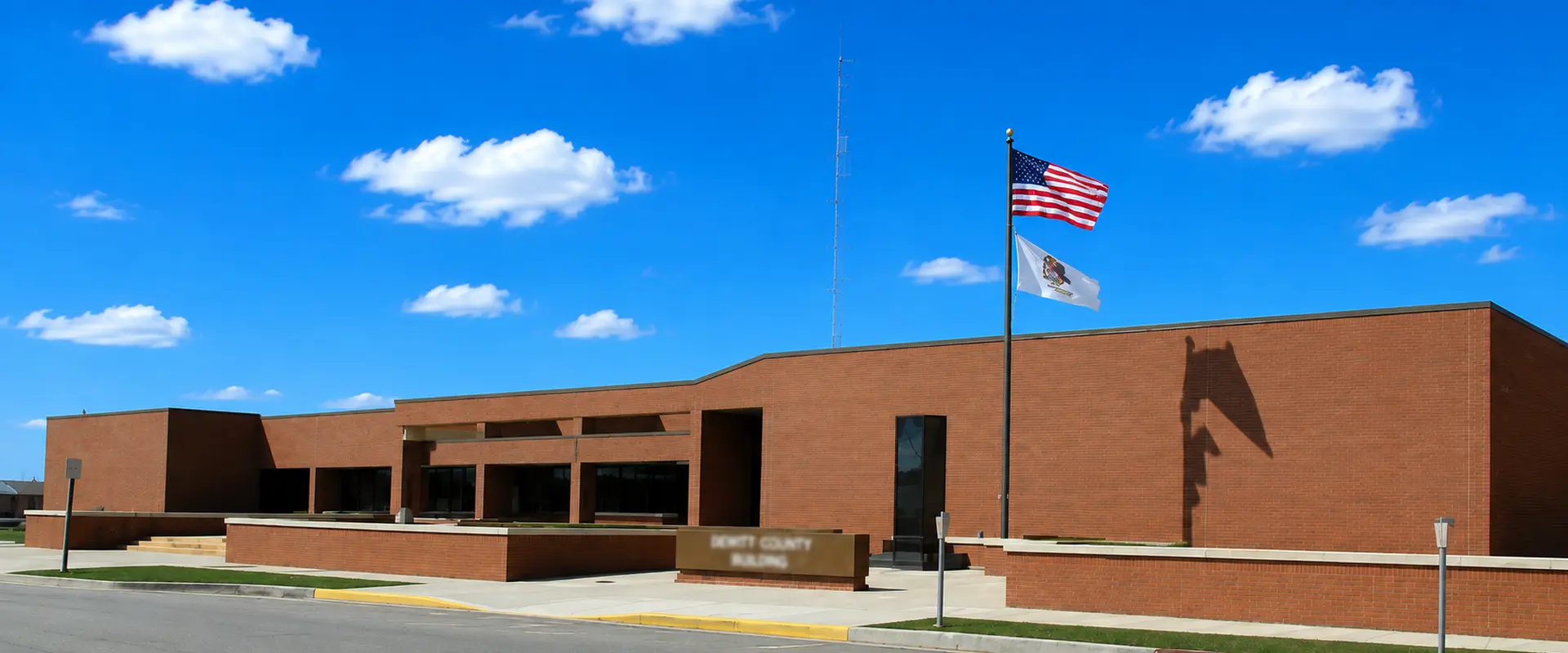
DeWitt County Courthouse
Houses the DeWitt County Circuit Court, which presides over all the cases filed in the county, including civil cases of all amounts, criminal cases, family law matters, small claims, landlord-tenant cases, and juvenile delinquency cases.
Clinton
Address: 201 West Washington Street, P.O. Box 439, Clinton, IL 61727
Phone (Circuit Clerk): (217) 935-7750
Phone (County Clerk and Recorder): (217) 935-7780
Website: DeWitt County Circuit Clerk
It's always best to double-check days and hours of court operation before heading over to the courthouse.
Legal Help and Self-Help Resources
DeWitt County residents do not have to navigate the Circuit Court alone, as they have access to several sources of help. Non-profit legal aid, court self-help resources, and law school clinics are all aimed at making the local court system more accessible.
 Free Legal Assistance
Land of Lincoln Legal Aid is accessible through the Easter Region Office in Champaign. The non-profit organization provides residents with free legal services covering housing, family law, consumer cases, public benefits, healthcare, senior law, education laws, and elder rights. However, note that the organization does not cover criminal cases, professional malpractice, or worker compensation cases. Residents have access to other free legal aid resources, such as the state-provided Illinois Legal Aid Online platform. This site provides free legal information, interview-based Easy Forms that generate complete court documents, and a directory of legal aid providers in the county.
 Local Legal Support
Residents also have access to a law school clinic that offers legal support. The University of Illinois College of Law in Urbana-Champaign, which sits in the same Sixth Judicial Circuit, makes it the most accessible law school clinic for county residents. The clinic offers access to the Family Advocacy Clinic, Immigration Law Clinic, the Veteran Legal Clinic, the First Amendment Clinic, and the Community Preservation Clinics. Residents also have access to local legal support from the Circuit Clerk's office. The staff at this office can provide them with the required legal forms, explain filing instructions, point filers to the right procedural rules, and confirm what the court calendar shows. Note that the staff is not allowed to give legal advice.
FAQs
How do I look up a case in the DeWitt County Circuit Court online?
The platform that the Circuit Court uses is a free public search site that lets one find cases by case number, party name, or filing year. Viewing docket entries, hearing dates, and dispositions is also possible through the platform. For faster results, have a case number or the full legal name of a party ready before searching. The DeWitt County Circuit Clerk can also confirm cases that don't display online due to their age, not yet being updated in the system, or being restricted, such as certain family or juvenile cases.
What's the difference between the DeWitt County Circuit Clerk and the County Clerk?
Both offices are located in the same Clinton courthouse, but they handle different records. The Circuit Clerk maintains court records for civil filings, criminal cases, traffic cases, family law cases, probate cases, and small claims cases. Meanwhile, the Clerk and Recorder maintains vital records (births, deaths, marriages), election and voter registration data, and recorded land documents, such as deeds and mortgages. Basically, one deals with court records while the other focuses on vital records and daily life in the county.
Can I appear remotely for a DeWitt County court hearing?
Often, yes. Under Appendix D of the Sixth Judicial Circuit's local rules, those taking part in the case may attend most non-evidentiary proceedings remotely without advance approval. Evidentiary hearings, trials, and final pretrials still require the presiding judge's approval and a written request. Make sure to check with the DeWitt County Circuit Clerk's office before the hearing date, since procedures vary by case type and courtroom.
Where can I find DeWitt County court records from decades ago?
Historical DeWitt County court files, including 19th- and early 20th-century civil, criminal, probate, and chancery records, are stored at the Illinois Regional Archives Depository (IRAD) at Illinois State University in Normal. Requests from records from IRAD are made by mail or phone at (309) 452-6027 (email requests are not accepted). More recent records remain at the DeWitt County Circuit Clerk's office in Clinton.
How do I research a DeWitt County case if the party has filings in other counties as well?
While the DeWitt County Circuit Clerk's platform lists DeWitt County cases individually, parties' records are often spread across multiple jurisdictions, counties, or states. Aggregated services like CourtCaseFinder pull civil, criminal, divorce, and arrest filings from multiple Illinois counties and other states into one searchable interface, which is useful when a party's footprint extends beyond DeWitt or when unsure which office holds the record.
Other Counties in Illinois
- Adams
- Alexander
- Bond
- Boone
- Brown
- Bureau
- Calhoun
- Carroll
- Cass
- Champaign
- Christian
- Clark
- Clay
- Clinton
- Coles
- Cook
- Crawford
- Cumberland
- Dekalb
- Douglas
- Dupage
- Edgar
- Edwards
- Effingham
- Fayette
- Ford
- Franklin
- Fulton
- Gallatin
- Greene
- Grundy
- Hamilton
- Hancock
- Hardin
- Henderson
- Henry
- Iroquois
- Jackson
- Jasper
- Jefferson
- Jersey
- Jo Daviess
- Johnson
- Kane
- Kankakee
- Kendall
- Knox
- La Salle
- Lake
- Lawrence
- Lee
- Livingston
- Logan
- Macon
- Macoupin
- Madison
- Marion
- Marshall
- Mason
- Massac
- Mcdonough
- Mchenry
- Mclean
- Menard
- Mercer
- Monroe
- Montgomery
- Morgan
- Moultrie
- Ogle
- Peoria
- Perry
- Piatt
- Pike
- Pope
- Pulaski
- Putnam
- Randolph
- Richland
- Rock Island
- Saint Clair
- Saline
- Sangamon
- Schuyler
- Scott
- Shelby
- Stark
- Stephenson
- Tazewell
- Union
- Vermilion
- Wabash
- Warren
- Washington
- Wayne
- White
- Whiteside
- Will
- Williamson
- Winnebago
- Woodford
Table of Contents
